Identity Graph
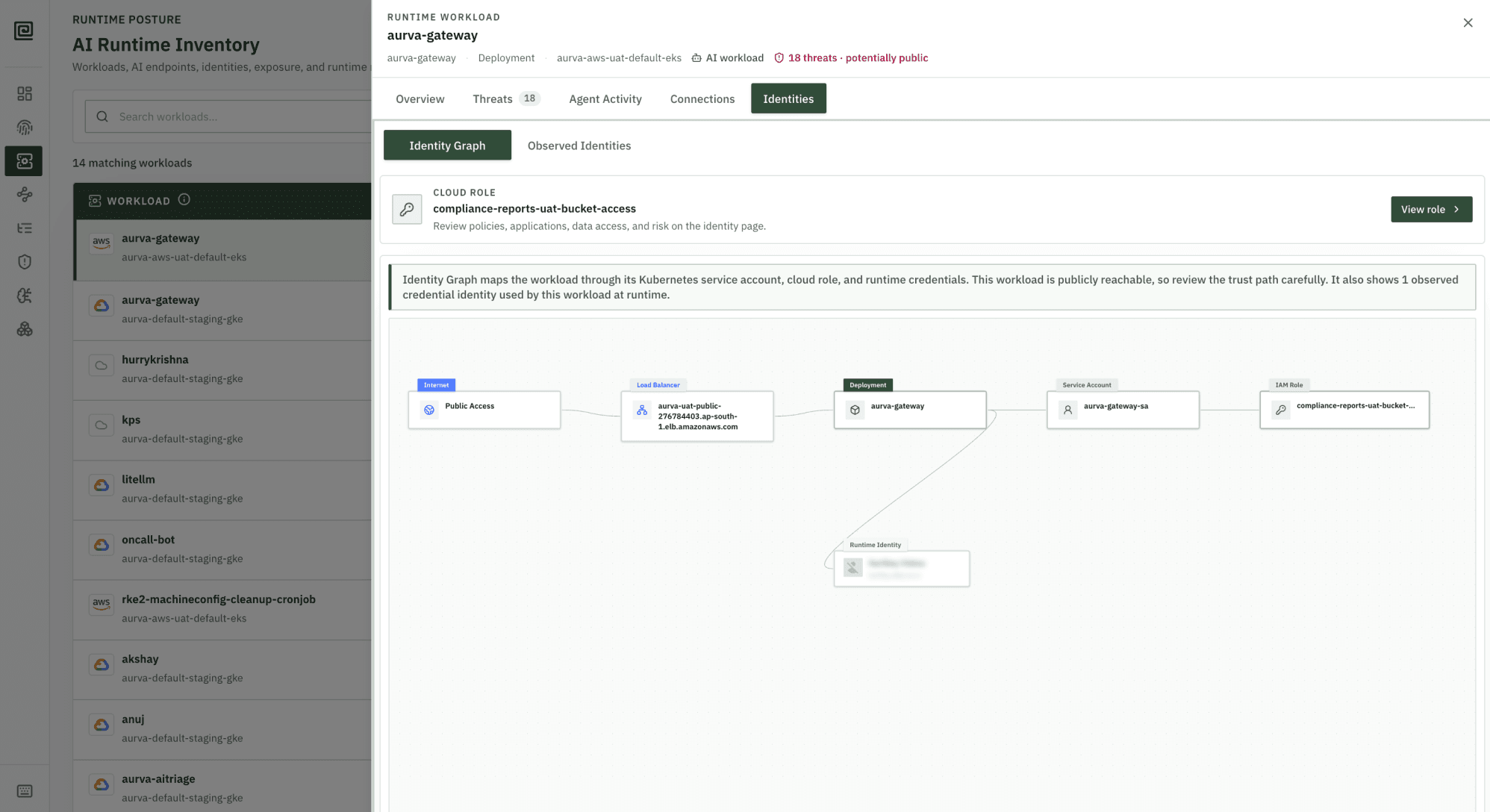
Aurva connects Agents, NHIs, Services, workloads, database users, permissions, queries, sensitive data, and downstream movement into one runtime graph.
Permissions tell you what could happen. Aurva's runtime identity graph tells you what actually happened — linking every identity to the sensitive data it touched and where that data moved next.
Full Identity Chain
From AI agent or service account to DB user to sensitive column — every hop mapped.
Runtime Over Entitlements
Not what was allowed, but what was executed, what was touched, and what moved.
Context Drift Detection
Flag when access falls outside expected scope — by agent, workload, or data type.
Identity graphs map possible access. Data graphs map sensitive data. Aurva connects identity, workload, query, data touched, and movement at runtime.
Who can access what
Maps identities, roles, permissions, and entitlement paths.
Where sensitive data lives
Maps data stores, classifications, and sensitive fields.
What actually happened
Shows which service, NHI, or agent touched sensitive data, what it queried, whether it was expected, and where the data moved next.
From possible access to runtime evidence. Built for service, NHI, and agent-driven access across production environments.
Aurva builds a runtime graph connecting identity, permissions, data sensitivity, queries, behavior, and movement — across cloud, databases, and downstream services.
Who acted, and through what.
Aurva maps the full identity stack: service account, IAM role, workload, pod, application, database user, AI agent, and delegated identity. Not just the surface — the whole chain of who or what executed the access.
What the identity could do.
Map what every identity is allowed to access — including inherited permissions, unused entitlements, excessive scopes, toxic combinations, and cross-environment reach. Understand the full blast radius before an incident happens.
What the identity actually did.
Track every query executed, every database, schema, table, and column touched. Surface volume, frequency, new access patterns, first-time access, and unusual behavior. This is the gap between entitlement and execution.
Where sensitive data went.
Classify the sensitive data that was touched, understand its business context, and trace where it moved next — internal services, external destinations, AI tool calls, API responses, and agent context windows. Detect egress and context drift before they become incidents.
Static identity graphs show what is configured. Aurva shows what actually happened — and gives you the evidence to act on it.
Which service touched PCI data for the first time?
Detect first-time access to regulated data by any identity — and flag it before it becomes a compliance finding.
Which AI agent accessed customer data outside its expected scope?
Surface context drift when an agent's data access falls outside its declared intent or operational boundary.
Which role has broad access but only uses 5% of it?
Quantify the gap between entitlement and execution. Shrink permissions to what is actually needed.
Which identity moved sensitive data outside the approved path?
Trace data movement from query to destination. Detect unauthorized egress before it becomes a breach.
Which database user maps back to which cloud role or workload?
Close the attribution gap. Map every DB session identity back to its cloud principal and originating workload.
From least privilege to agentic governance, every capability is grounded in what actually happened at runtime.
Least Privilege Enforcement
Close the gap between what identities are allowed and what they actually use. Reduce permissions to what runtime evidence supports.
NHI Governance
Govern non-human identities — service accounts, API keys, and machine credentials — with visibility into their actual data behavior.
Agentic Access Monitoring
Track what every AI agent accessed, what sensitive data it touched, and whether its behavior matched its declared intent.
Data Access Investigation
Reconstruct any access event end-to-end: which identity, which workload, which query, which sensitive data, where it went.
Blast-Radius Analysis
Before an incident, understand how far a compromised identity could reach. After one, understand exactly how far it did.
Context Drift Detection
Alert when access deviates from expected patterns — new data types, unusual destinations, or access outside normal operating windows.
Evidence-Backed Remediation
Remove permissions with evidence, not guesswork. Every recommendation is grounded in observed runtime activity.
You now know who touched sensitive data, and whether it was appropriate.
Identity + Runtime + Data. The full chain is connected.
USA
AURVA INC. 1241 Cortez Drive, Sunnyvale, CA, USA - 94086
India
Aurva, 4th Floor, 2316, 16th Cross, 27th Main Road, HSR Layout, Bengaluru – 560102, Karnataka, India
Platform
Solutions
Resources
Resource Library
Company
USA
AURVA INC. 1241 Cortez Drive, Sunnyvale, CA, USA - 94086
India
Aurva, 4th Floor, 2316, 16th Cross, 27th Main Road, HSR Layout, Bengaluru – 560102, Karnataka, India
Platform
Solutions
Resources
Resource Library
Company
USA
AURVA INC. 1241 Cortez Drive, Sunnyvale, CA, USA - 94086
India
Aurva, 4th Floor, 2316, 16th Cross, 27th Main Road, HSR Layout, Bengaluru – 560102, Karnataka, India
Platform
Solutions
Resources
Resource Library
Company