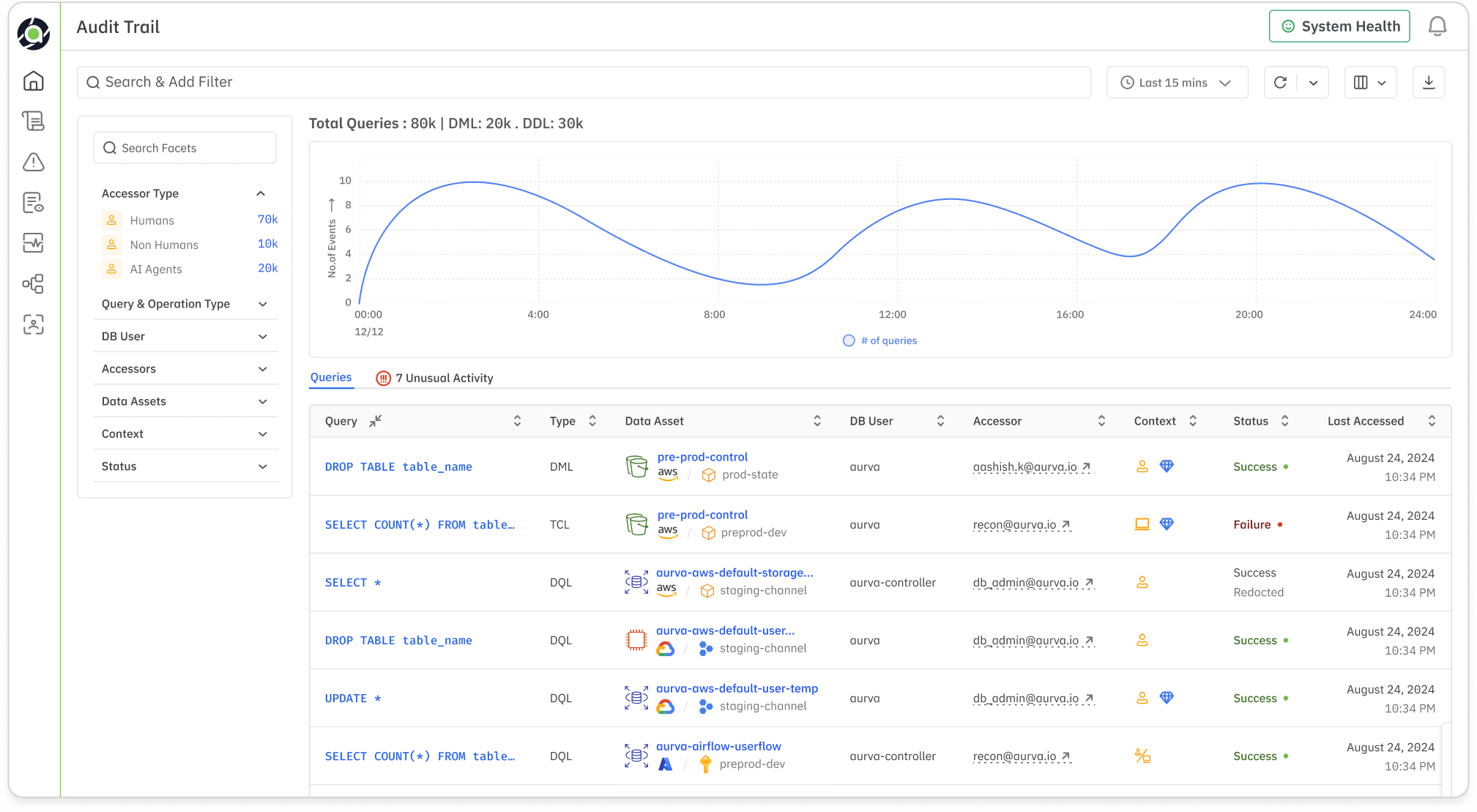
Data Activity Monitoring

DAM for the AI Era

Monitor every database query — from humans, service accounts, and AI agents — and block threats in real time, without touching performance.

Full Identity Context
No Performance Tax
AI Native
DFM Hero Showcase

TRUSTED BY LEADING ENTERPRISES WORLDWIDE

razorpaymeeshojupiterbounce-infinityapnaqorefampaypaytmtanlamplyubinykaayubirazorpaymeeshojupiterbounce-infinityapnaqorefampaypaytmtanlamplyubinykaayubirazorpaymeeshojupiterbounce-infinityapnaqorefampaypaytmtanlamplyubinykaayubirazorpaymeeshojupiterbounce-infinityapnaqorefampaypaytmtanlamplyubinykaayubi
The Blindspot

Legacy DAM: built for the past, blind to the present.

Blind to modern infrastructure

Ephemeral DBs, serverless, managed services — legacy DAM wasn’t designed for how infrastructure works today

Knows the Account. Not the Actor.

Logs show service_account_47. Not who’s behind it, what else they can access, or whether this is normal.

Logs with No Answers.

You get a SQL query and a username. Not whether it was anomalous, who the actor really is, or what data was at risk.

Legacy DAM Icon
Green Bulb IconSolution

This should be flagged as an active breach.

See the Query.Know the Actor.Understand what it means.
Anomaly escalated. Export blocked per policy.Traced to: anne.matt@corp.com query at 3:47 am Sat.First time querying the payments tableSELECT SSN — 847k record, Tor exit node, UK.OSRisk: 94

Authorized ≠ Appropriate Aurva shows you both.

image

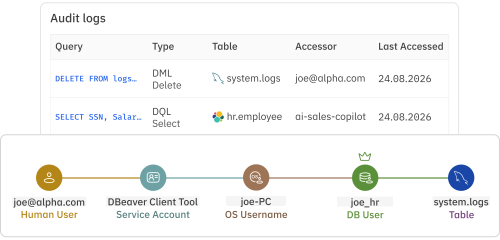
Know who's really behind every database query

Every query resolved to the real actor — human, service account, or AI agent — with role, application, and access path. Investigate in seconds instead of hours.

image

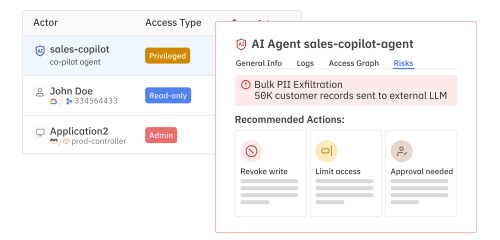
Detect AI agents accessing sensitive data

Know which AI agent accessed what data, who invoked it, and whether the pattern is normal. Have behavioral baselines per agent and get alerted the moment something deviates

image

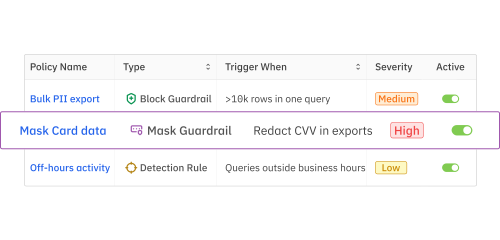
Enforcement without impacting workflows

Enforce by identity, data sensitivity, location, and timing: Block contractors from customer tables, redact payment columns for analysts, block untrusted sources, prevent off-hours PII queries. All with zero production impact
image

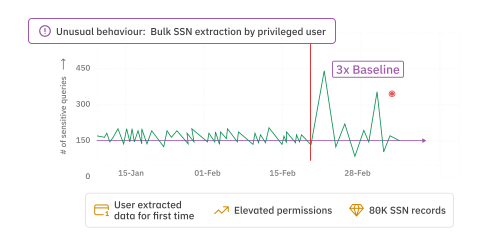
Catch what rules misses

Rules can't catch what they weren't written for. Aurva baselines normal behavior per user, application, and AI agent — and flags when something breaks pattern, even if no rule was triggered.

CockroachDB
Redis
PostgreSQL
Snowflake
Google BigTable
MySQL
Amazon S3
MongoDB
DynamoDB
Google BigQuery
CockroachDB
Redis
PostgreSQL
Snowflake
Google BigTable
MySQL
Amazon S3
MongoDB
DynamoDB
Google BigQuery
CockroachDB
Redis
PostgreSQL
Snowflake
Google BigTable
MySQL
Amazon S3
MongoDB
DynamoDB
Google BigQuery
CockroachDB
Redis
PostgreSQL
Snowflake
Google BigTable
MySQL
Amazon S3
MongoDB
DynamoDB
Google BigQuery
MariaDB
Valkey
Azure Blob Storage
Oracle
Amazon Aurora
Apache Kafka
Trino
Cassandra
MariaDB
Valkey
Azure Blob Storage
Oracle
Amazon Aurora
Apache Kafka
Trino
Cassandra
MariaDB
Valkey
Azure Blob Storage
Oracle
Amazon Aurora
Apache Kafka
Trino
Cassandra
MariaDB
Valkey
Azure Blob Storage
Oracle
Amazon Aurora
Apache Kafka
Trino
Cassandra
AlloyDB
Amazon Redshift
Azure Cosmos DB
ScyllaDB
CockroachDB
Redis
PostgreSQL
Snowflake
Google BigTable
AlloyDB
Amazon Redshift
Azure Cosmos DB
ScyllaDB
CockroachDB
Redis
PostgreSQL
Snowflake
Google BigTable
AlloyDB
Amazon Redshift
Azure Cosmos DB
ScyllaDB
CockroachDB
Redis
PostgreSQL
Snowflake
Google BigTable
AlloyDB
Amazon Redshift
Azure Cosmos DB
ScyllaDB
CockroachDB
Redis
PostgreSQL
Snowflake
Google BigTable

Any database Easy deployment

and more ...

Deployment:

Agent
Agentless
CombinedCloud
On-prem
Hybrid

Chosen by teams who need evidence, not guesses

diamond bg 1

20Bn+

Queries monitored daily

diamond bg 2

<2%

False Positive rate 98% alerts are real

quote

(With Aurva DAM) We’re proactively catching anomalies, enforcing least privilege, and closing security gaps before they become incidents.

Manikandan Rajappan

Manikandan Rajappan

Staff Security Engineer · Razorpay

quote

As one of the only cloud-native banks, Aurva was the only DAM tool that gave us real-time, granular visibility into database access — critical for meeting banking Infosec norms.

S. Mukharjee

S. Mukharjee

CISO, Northeast SF Bank

diamond bg 3

0ms

impact on application performance

VS ALTERNATIVES

Agent based5-10% CPU
Native logs20-40% DB CPU
Proxy based5-10ms latency

FAQ

Frequently Asked Questions

What is database activity monitoring (DAM)?

open-icon

Database activity monitoring (DAM) is a security control that continuously records and analyzes every query made against a database, who ran it, what they accessed, and whether it deviates from normal behavior, so security teams can detect misuse, enforce least privilege, and meet compliance requirements like PCI-DSS, SOX, and HIPAA. Traditional DAM tools rely on native database logs or network taps; modern, AI-era DAM tools like Aurva also resolve queries back to the actual human, service account, or AI agent responsible, not just a shared credential.

What's the difference between DAM and DSPM?

open-icon

Database activity monitoring (DAM) watches activity: the live stream of queries hitting a database in real time. Data security posture management (DSPM) assesses posture: where sensitive data lives, how it's classified, and who has standing access to it, typically as a point-in-time or periodic scan. The two are complementary: DSPM tells you where your risk is; DAM tells you when that risk is being exploited. Aurva runs both from a single runtime platform so posture findings and live activity share the same identity and data-sensitivity context.

Can DAM tools detect AI agents accessing a database?

open-icon

Most legacy DAM tools cannot. They were built to log queries by service account or connection string, so an AI agent using a shared database credential looks identical to any other automated process: the tool sees the account, not the actor. Aurva was built specifically to close this gap: it resolves every query to the real actor (human, service account, or AI agent), builds a behavioral baseline per agent, and flags deviations, for example when an AI agent suddenly queries a table outside its normal scope.

Does database activity monitoring slow down my database?

open-icon

It depends on the architecture. Agent-based DAM tools typically add 5-10% CPU overhead on the monitored host; native-logging approaches can add 20-40% database CPU overhead at high query volume; proxy-based tools add 5-10ms of latency per query because traffic is rerouted through a middle layer. Aurva uses a passive, out-of-band architecture that reads traffic without sitting in its path, which is how it monitors 20Bn+ queries per day across customer environments with 0ms added application latency.

What's the best database activity monitoring solution for cloud-native and serverless databases?

open-icon

Legacy DAM tools (Oracle Audit Vault, native database auditing, most agent-based products) were designed for long-lived, on-prem database servers and often lose visibility when databases are ephemeral, serverless, or auto-scaled: the agent or log pipeline can't keep up with instances that spin up and down. Aurva was built agentless-first for cloud-native environments, with agent, agentless, and hybrid deployment modes, and covers 25+ data stores including PostgreSQL, MySQL, MongoDB, Snowflake, BigQuery, DynamoDB, and Kafka.

How is "authorized" different from "appropriate" database access?

open-icon

Authorization is a static grant: a role or permission that says an identity can query a table. Appropriateness is contextual: whether that specific query, at that specific time, from that specific actor, matches how the data is supposed to be used. A finance analyst with legitimate read access to a customer database is authorized to query it; that same analyst exporting the entire table at 2am from an unfamiliar location is authorized but not appropriate. Legacy DAM and IAM tools only check the first condition. Aurva checks both, in real time.

How much does database activity monitoring cost?

open-icon

DAM pricing varies widely by vendor and is typically based on number of monitored database instances, data volume, or number of protected data stores, and is rarely published publicly by enterprise vendors (IBM Guardium, Imperva, Oracle) since it's negotiated per deployment. Contact Aurva directly for pricing based on your environment. Get a demo to see a scoped quote.

From raw queries to real intelligence

See Aurva in action with your own database environment.

You now know who, and whether it was appropriate.

Authorized ≠ Appropriate. The full chain is connected.

Agent Access Data

Agents access data through chains, apart from queries.

Every chain is attributable.

AI-SPMRuntime Protection
Try Now
Sensitive Data Access

Sensitive data moves after every access.

Every Access is traceable.

DAMDSPM
Try Now
aicpa-logoiso-logo

© 2025 Aurva. All rights reserved.Terms of ServicePrivacy Policy

twitterlinkeding