Beyond Chatbots: Understanding AI Agents
AI agents are autonomous software systems that can perceive their environment, make decisions, and take actions to achieve specific goals, all without constant human supervision. Unlike traditional software that follows predetermined paths, or even generative AI that responds to prompts, agents operate with genuine autonomy.
Think of the difference this way:
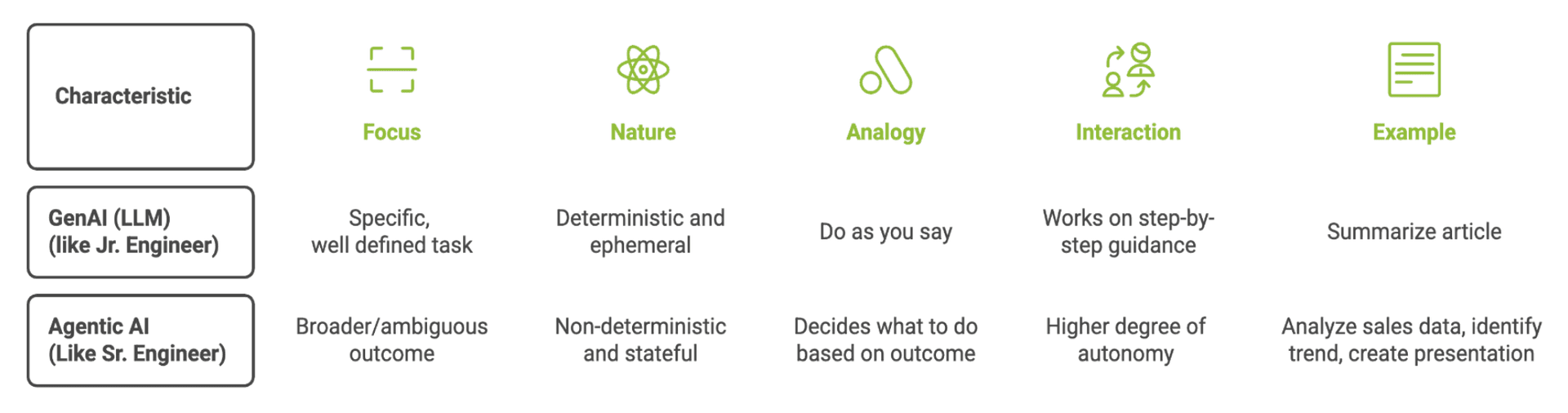
- Generative AI (like ChatGPT) is like a junior engineer. It executes specific tasks you assign: “Summarize this article” or “Write this code snippet.”
- AI agents are like senior engineers. You give them an outcome: “Analyze our sales data, identify trends, and create a presentation for the board.”
The agent then determines what needs to be done, breaks down the problem, accesses necessary tools and data, and delivers the complete solution.
The Four Pillars of Agent Computing
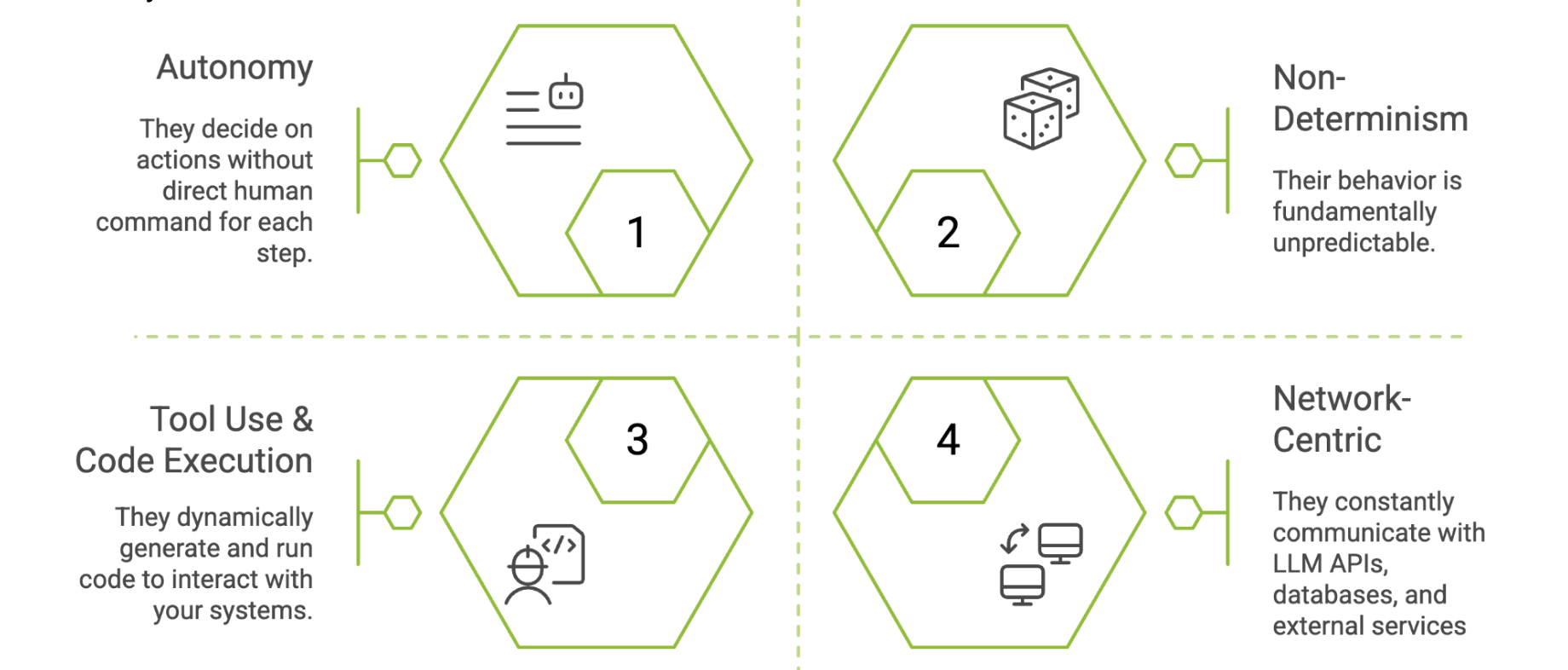
What makes AI agents fundamentally different from traditional applications? Four key characteristics:
1.Autonomy
Agents make decisions independently. When you ask an agent to “optimize our inventory,” it does not just run a predefined algorithm. It can analyze current stock levels, predict demand, evaluate supplier relationships, and potentially even initiate purchase orders, all based on its own reasoning about the best path forward.
2. Non Determinism
The same request to an agent might yield different approaches each time. This is not a bug. It is a feature. Agents adapt their strategies based on context, available resources, and learned experiences. Their behavior is fundamentally unpredictable in its specifics, even while they aim for predictable outcomes.
3. Tool Use and Code Execution
Modern agents do not just process information. They actively interact with your systems. They can:
- Query databases to retrieve customer information
- Call APIs to integrate with external services
- Generate and execute code to solve novel problems
- Orchestrate complex workflows across multiple systems
4. Network Centric Architecture
Agents are inherently collaborative. They communicate with:
- Large Language Models (LLMs) for reasoning and natural language processing
- Other agents for task delegation and specialized expertise
- Databases and knowledge bases for information retrieval
- External APIs and services for extended capabilities
How Agents Actually Work
Let us trace through a real scenario to understand agent operations.
Scenario: A sales agent receives a request for a custom quote.
- Understanding intent: The agent first calls an LLM API (like GPT 4) to parse and understand the customer’s request.
- Information gathering: Using protocols like MCP (Model Context Protocol), it queries your customer database to retrieve purchase history and preferences.
- Delegation: Through an A2A (Agent to Agent) protocol, it delegates pricing calculations to a specialized pricing agent.
- Integration: The pricing agent accesses your pricing API, applies relevant discounts, and calculates the final quote.
- Response generation: The sales agent compiles all information and generates a personalized response.
Each step involves autonomous decision making. The agent determines which databases to query, what information is relevant, which specialized agents to involve, and how to present the final response, all without explicit programming for this specific scenario.
The Protocol Revolution: MCP, A2A, and ACP
The real power of agents emerges through standardized communication protocols:
- MCP (Model Context Protocol): Enables agents to discover and use tools. Think of it as the API that lets an AI access your calculator, web search, or database.
- A2A (Agent to Agent Protocol): Allows specialized agents from different vendors to collaborate, such as a translation agent working with a content creation agent.
- ACP (Agent Communication Protocol): Provides structured, secure communication for agents within enterprise environments.
These protocols transform isolated AI capabilities into interconnected, collaborative systems that can tackle complex, multi step problems.
The Enterprise Impact
For businesses, agents represent both an opportunity and a challenge.
The Opportunity
- Autonomous handling of complex workflows
- 24/7 operation without human intervention
- Dynamic problem solving that adapts to new situations
- Seamless integration across multiple systems and data sources
Used correctly, agents can compress multi step human workflows into a single request and response. They become always on operators sitting across support, finance, engineering, and operations.
The Challenge
- Visibility: How do you monitor ephemeral processes that generate code on the fly and terminate in seconds?
- Governance: How do you ensure agents comply with policies when their behavior is non deterministic and context dependent?
- Security: How do you prevent unauthorized data access when agents operate autonomously across tools, APIs, and datasets?
Traditional monitoring and access control systems were built for predictable applications and human users. Agents cut across both.
Why Agents Are Different from Any Identity That Exists So Far
Traditional enterprise systems deal with predictable entities. Users have defined roles, applications have fixed behaviors, and services follow predetermined patterns. Security and governance frameworks are built around these assumptions.
Agents shatter those assumptions.
They are not users, they are not applications, and they are not services. They are something entirely new: adaptive, autonomous entities that blur the boundaries between all three.
Unlike any identity we have dealt with before, agents can:
- Spawn new processes and workflows on their own
- Make independent decisions about which tools and APIs to call
- Create or coordinate with other agents
- Move across multiple systems and data boundaries in a single run
They operate in a gray zone that traditional security and governance frameworks were not designed to handle. Even when every MCP tool is individually well scoped and monitored, the way agents chain these together creates a new, emergent attack and governance surface.
This is not just an evolution of existing computing paradigms. It is a shift that demands fundamentally new approaches to visibility, control, and trust.
In our next post, we will dive deep into why agents represent a completely new class of identity and the unique security and governance challenges they present. We will explore how their ephemeral nature, emergent behaviors, and ability to traverse traditional security boundaries make them unlike anything enterprise IT has encountered before.
About the authors
Apurv is the co founder of Aurva and a former AI engineering leader at Meta. He combines deep experience in building large scale AI systems with hands on security work at Aurva, and is passionate about bridging the gap between data and AI teams and security teams.
Basuraj is Head of AI Products at Uniphore and an AI strategist focused on applied machine intelligence. He has spent the last decade building conversational AI systems, leading AI engineering teams, and shaping product strategy across high-growth startups and enterprise platforms.
Aurva’s AIOStack provides visibility into agent operations using eBPF technology to monitor AI activities at the kernel level, helping enterprises understand what their agents are doing, which data they touch, and how they interact with the rest of the environment.
Get started with AIOStack Community Edition → https://github.com/aurva-io/AIOstack
Read More on → https://aurva.ai/
Join our Slack community → https://join.slack.com/t/aiostack-aurva/shared_invite/zt-3idcrvhdx-3ExhxVeMTGjYsqPgKPDd_Q