Every security tool hits the same wall: encrypted traffic. Here's how we broke through it using eBPF.
The Invisible Problem
Picture this: You've just deployed a comprehensive database security monitoring system. It tracks every query, flags suspicious access patterns, and alerts on potential data breaches. Your CISO is happy. Your compliance team is thrilled.
Then you push to production.
Suddenly, your beautiful monitoring system goes dark. Zero queries captured. No alerts. Complete silence.
What happened? Production databases use SSL/TLS. Always. Non-negotiable.
And your monitoring tool? It just became useless.
Why SSL/TLS Breaks Everything
Let's understand why this is such a fundamental problem.
Production Reality: SSL is Non-Negotiable
In production environments, SSL/TLS isn't optional—it's mandatory:
- Compliance requirements (PCI-DSS, HIPAA, SOC2) explicitly require encrypted database connections
- Cloud providers enforce TLS by default (AWS RDS, Google Cloud SQL, Azure Database)
- Zero-trust architectures assume all network traffic is hostile
- Data protection regulations (GDPR, CCPA) mandate encryption in transit
Your database monitoring solution must work with SSL. There's no "we'll add SSL support later" option.
The Traditional Solutions All Have Fatal Flaws
When we started building Aurva's database security platform, we evaluated every existing approach:
Option 1: MITM Proxy (The "Breaking Security to Add Security" Paradox)
The traditional enterprise approach: terminate SSL at a proxy, inspect the traffic, re-encrypt it.
Why it fails:
- You're breaking end-to-end encryption. The entire point of TLS is to prevent man-in-the-middle attacks. You're literally implementing one.
- Certificate management nightmare. Every database client needs to trust your proxy's certificate. Good luck deploying that across 1000 microservices.
- Added latency. Every query goes through an extra hop: decrypt → inspect → re-encrypt. That's 2-5ms added to every single query.
- Single point of failure. Your proxy goes down? Your entire database layer is unreachable.
Companies are rightfully afraid of inline solutions. We've heard this fear repeatedly from security teams: "We can't put anything in the critical path. One bug and we take down production."
Option 2: Database Audit Logs (The "Trust But Don't Verify" Approach)
Most databases have built-in audit logging. PostgreSQL has pgaudit, MySQL has the audit plugin.
Why it's insufficient:
- Only sees server-side activity. If an attacker compromises a database user's credentials, the audit log just shows "legitimate" queries.
- Can be disabled. Attackers with admin access turn off logging first.
- No client attribution. Who ran that query? The audit log says "postgres user from 10.0.2.15". Which of your 50 microservices is that?
- Performance overhead. Audit logging can add 20-40% CPU load on the database server itself.
Option 3: Application-Level Instrumentation (The "Boil the Ocean" Strategy)
Instrument every application that touches databases. Add logging to every ORM, every database client library.
Why it doesn't scale:
- You need to instrument everything. Python, Node.js, Java, Go, Ruby, .NET—each with multiple database libraries.
- Code changes in every microservice. That's months of engineering work across dozens of teams.
- Developers will disable it. When debugging production issues, the first thing devs do is remove "non-essential" code.
- Partial coverage is worse than no coverage. You think you're monitoring all database access, but you're missing that one legacy service still using raw SQL.
What We Actually Needed
For Aurva, the requirements were non-negotiable:
- ✅ Zero application changes - Works with any database client, any language
- ✅ Out-of-band monitoring - Never in the request path, can't cause outages
- ✅ SSL-transparent - Captures plaintext without breaking encryption
- ✅ Full attribution - Knows which process, user, container made each query
- ✅ Production-safe - Sub-1% overhead, graceful degradation on failures
This seemed impossible. How do you see inside encrypted connections without decrypting them?
The Insight: Catch Data Before Encryption
Here's the key realization: SSL/TLS encryption happens in user space, not the kernel.
When your application calls SSL_write() or SSL_read(), the plaintext data exists in memory for a brief moment before OpenSSL encrypts it. If we could hook those functions at the kernel boundary...
Enter eBPF.
A Quick eBPF Primer
eBPF (extended Berkeley Packet Filter) lets you run sandboxed programs in the Linux kernel without changing kernel code or loading kernel modules. Originally designed for packet filtering, it's evolved into a general-purpose observability framework.
Think of it as a virtual machine inside the kernel:
- You write programs in a restricted C subset
- The kernel's verifier checks for safety (no infinite loops, no crashes, bounded execution time)
- Programs attach to kernel events (system calls, function calls, network packets)
- When events fire, your program runs with full kernel visibility
Why eBPF for SSL monitoring?
- Can't be disabled by applications - Runs in kernel space, outside application control
- Out-of-band - Never in the application's execution path
- Safe - The verifier guarantees programs can't crash the kernel
- Fast - Runs in kernel context, no user-space context switches for hot paths
Uprobes: eBPF Meets User Space
While eBPF started with kernel instrumentation, uprobes (user-space probes) extend it to user-space functions.
Uprobes let you attach eBPF programs to any function in user-space libraries. When that function is called, your eBPF program runs—capturing arguments, return values, and memory contents.
Here's the genius part: uprobes run in kernel context, so applications can't disable them. They're completely transparent to the application code.
The plan:
- Hook OpenSSL's
SSL_read() and SSL_write() functions - Capture the plaintext buffer before encryption (write) or after decryption (read)
- Correlate with TCP connection metadata to attribute to processes
- Send to user-space for protocol parsing and analysis
Sounds simple, right?
The First Wall: OpenSSL Doesn't Have a Stable API
We quickly discovered the first problem: OpenSSL's internal structures change between versions. And by "change," I mean completely restructure.
The struct_st Nightmare
To extract the socket file descriptor from an SSL connection (so we can correlate encrypted traffic with actual network connections), we need to traverse OpenSSL's internal SSL structure:
SSL context → BIO structure → socket FD
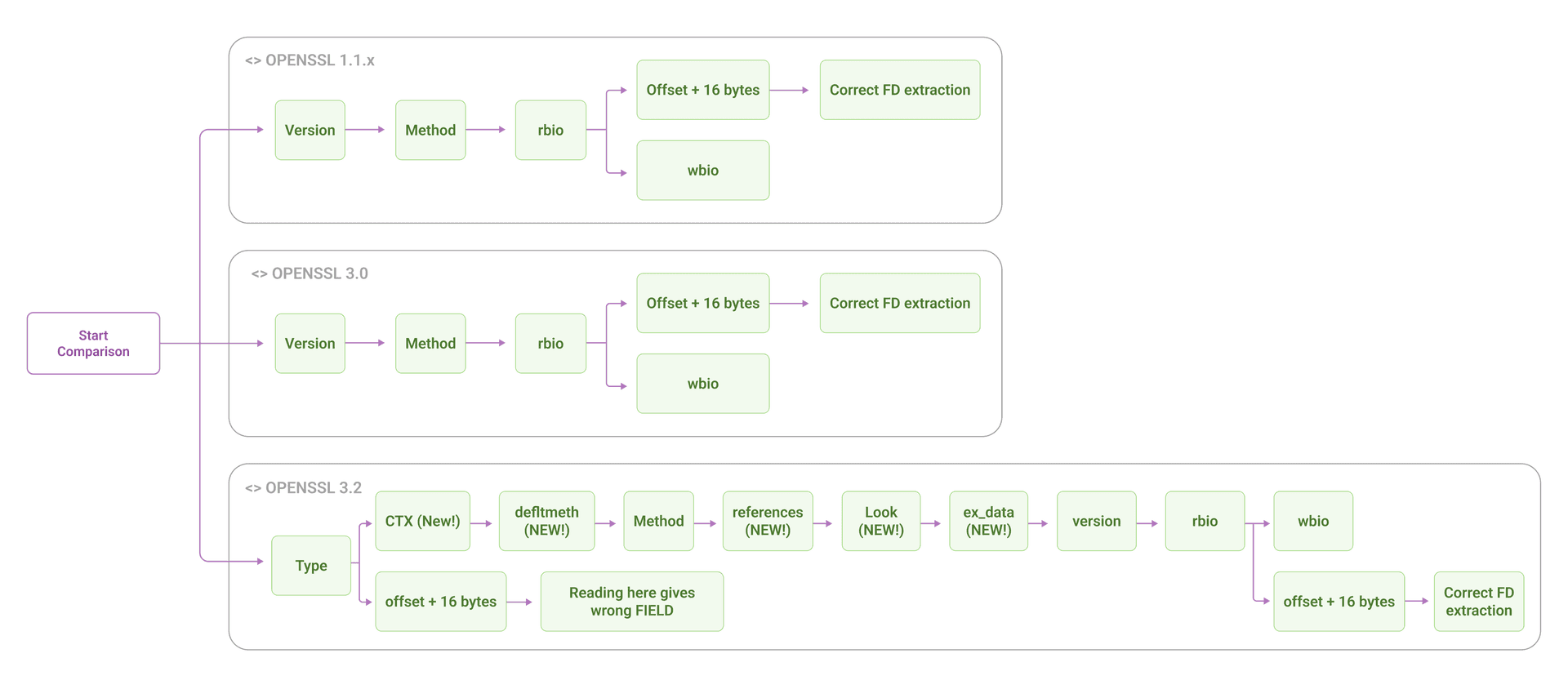
OpenSSL 1.1.x has a simple 4-field structure:
SSL {
  version
  method
  rbio → points to Read BIO → contains socket FD
  wbio → points to Write BIO
}
OpenSSL 3.0 restructured the BIO:
BIO {
  libctx        ← NEW FIELD!
  method
  callback
  ... 6 more fields ...
  num           ← The FD we need, now at a different offset
}
OpenSSL 3.2 added seven fields to the SSL structure:
SSL {
  type          ← NEW!
  ctx           ← NEW!
  defltmeth     ← NEW!
  method
  references    ← NEW!
  lock          ← NEW!
  ex_data       ← NEW!
  version
  rbio          ← Offset shifted by 56 bytes!
  wbio
}
OpenSSL 3.5 added another field before version.
Each version change shifts the memory offset of rbio and wbio. If we use the wrong structure definition, we're reading random memory and extracting garbage file descriptors.
The consequence: Silent data loss. No errors. No warnings. Your monitoring system just... misses events.
(See OpenSSL's ssl_st structure history for the gory details.)
The Challenge: We Can't Ask OpenSSL Its Version From eBPF
Here's where eBPF's safety restrictions become a problem. The eBPF verifier enforces strict rules to guarantee kernel safety:
You are restricted to:
- Calling only approved helper functions - No arbitrary function calls like
OpenSSL_version() - Simple, bounded string operations - Can't do regex matching or strlen() on unknown-length strings
- Pre-allocated, limited memory - No
malloc(), no dynamic allocation at runtime - Verifier rules vary by kernel version - Older kernels (pre-5.x) have even stricter limits on map lookups and loop unrolling (see eBPF verifier docs)
So we can't just call OpenSSL_version() and branch on the result. We need to handle multiple versions in the same eBPF program, using only the tools the verifier allows.
The Solution: Try Everything, Validate Everything
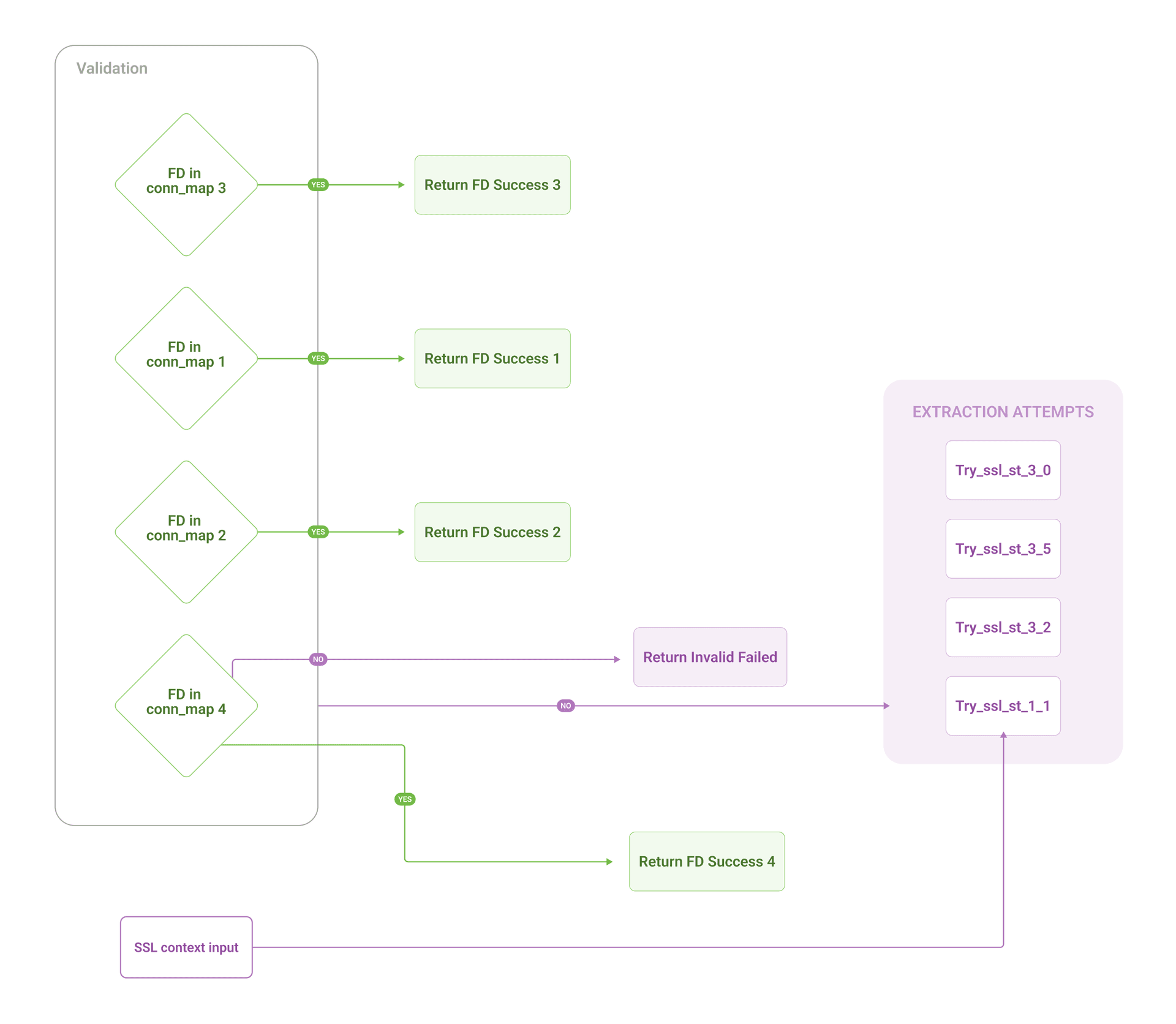
Our approach: Define all known structure layouts and try each one, validating against kernel state.
The Fallback Chain
get_fd_from_ssl_context(ssl_ptr) {
    // Try OpenSSL 1.x layout
    fd = read_using_v1_struct(ssl_ptr)
    if (fd_exists_in_connection_map(fd))
        return fd  // Success!

    // Try OpenSSL 3.0 layout
    fd = read_using_v3_0_struct(ssl_ptr)
    if (fd_exists_in_connection_map(fd))
        return fd

    // Try OpenSSL 3.2 layout
    fd = read_using_v3_2_struct(ssl_ptr)
    if (fd_exists_in_connection_map(fd))
        return fd

    // Try OpenSSL 3.5 layout
    fd = read_using_v3_5_struct(ssl_ptr)
    if (fd_exists_in_connection_map(fd))
        return fd

    return INVALID  // Couldn't extract FD
}
The key: We validate each extracted FD against our connection tracking map (populated by TCP tracepoints). If the FD exists and matches the process ID, we know we used the correct structure.
This prevents false positives from random memory values that happen to look like valid FDs (e.g., reading 0x00000003 from the wrong offset).
But Which Structure to Try First?
Before attaching uprobes, we detect OpenSSL versions from user space:
Step 1: Parse the ELF file
/proc/{pid}/maps → find libssl.so.3
/proc/{pid}/root/usr/lib/libssl.so.3 → open as ELF
Step 2: Search the .rodata section
.rodata contains string literals like "OpenSSL 3.0.13"
Regex match: "OpenSSL \d+\.\d+\.\d+"
Step 3: Map to structure version
3.0.x-3.1.x → use ssl_st_3_0
3.2.x-3.4.x → use ssl_st_3_2
3.5.x+      → use ssl_st_3_5
Fallback: If version detection fails (custom builds, stripped binaries), use filename heuristics:
.so.3 or .so.3.0 → Assume OpenSSL 3.x
.so.1.1          → Assume OpenSSL 1.1.x
This optimization means we try the correct structure first 95% of the time, avoiding unnecessary validation checks.
The Second Wall: One Uprobe Per Process is Too Expensive
Initial implementation: When a new database connection appears, scan /proc/{pid}/maps, find libssl.so, attach uprobes to SSL_read and SSL_write.
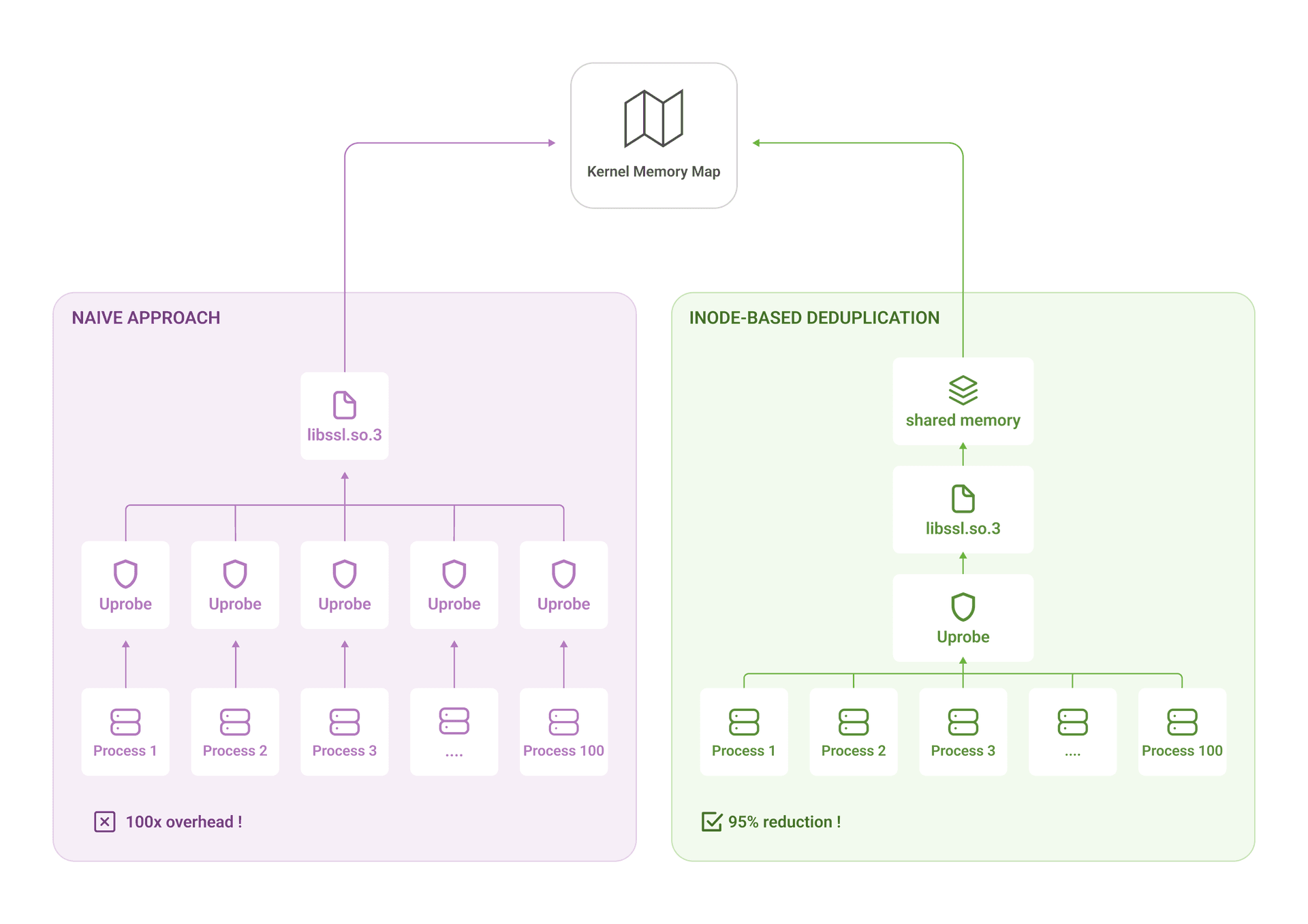
The problem: PostgreSQL has 100 worker processes. All using the same /usr/lib/libssl.so.3 file.
Naively, we'd attach 100 copies of the same uprobe. That's 100 context switches on every SSL read/write call.
The Realization: Libraries Are Shared in Memory
The Linux kernel uses memory-mapped files. When 100 processes load the same library, they're all pointing to the same physical memory pages.
That memory region has an inode identifier. If we track by inode instead of PID, we only attach once.
The Inode-Based Deduplication Pattern
For each new database connection:
  1. Find libssl.so in /proc/{pid}/maps
  2. Get the inode: stat(/proc/{pid}/map_files/{start_addr}-{end_addr})
  3. Check: Have we already attached to this inode?
     - Yes → Skip (already monitoring this library)
     - No → Attach uprobes, register inode
Impact: This reduced attachment overhead by 95%. Instead of O(processes), we're now O(unique libraries)—typically 2-3 per host.
The Third Wall: Go Applications Don't Use OpenSSL
Our OpenSSL hooking worked beautifully. Then we encountered a Go application.
Zero SSL events captured.
Why? Go doesn't use OpenSSL. It has its own crypto/tls implementation in pure Go.
The Go TLS Challenge
Go's crypto/tls library presents three new problems:
- No dynamic library - It's compiled directly into the Go binary
- No symbols in stripped binaries - We can't just hook
crypto/tls.(*Conn).Read - Calling convention changed - Go 1.17 switched from stack-based to register-based parameters
We can't hook a library that doesn't exist. We need to hook the binary itself.
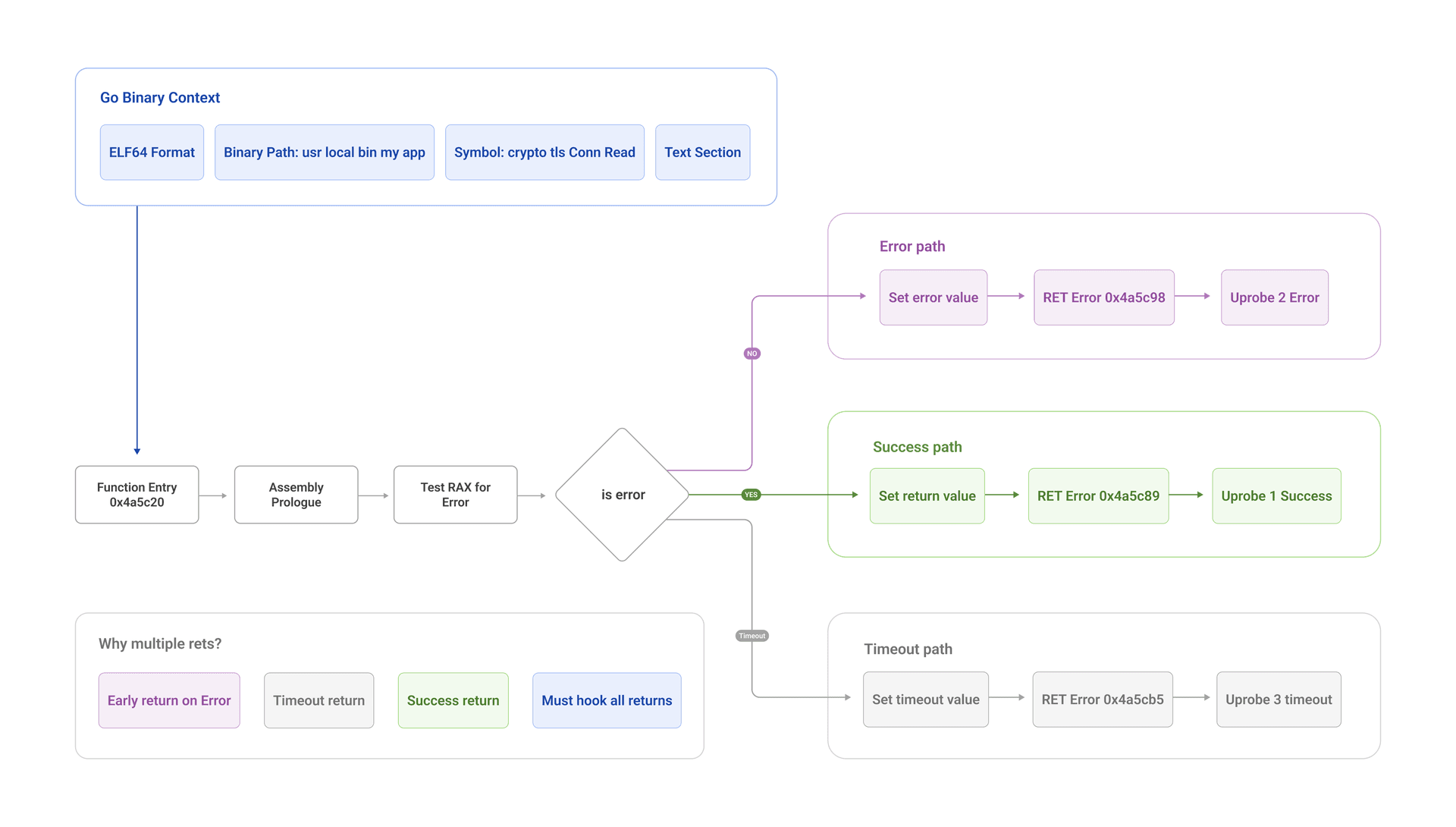
The Solution: Disassemble and Hook RET Instructions
Here's what we do:
Step 1: Detect Go binaries
Check ELF file for ".note.go.buildid" section
Parse Go build info to get version
Step 2: Find the crypto/tls.(Conn).Read symbol
Even stripped binaries keep some symbols for runtime
Symbol table contains function boundaries
(See Go's symbol table format: https://pkg.go.dev/debug/gosym)
Step 3: Disassemble the function
Read machine code bytes from .text section
Scan for RET instructions (opcode 0xC3 on x86_64)
Record offset of each RET
Step 4: Hook every RET instruction
For each RET offset:
  Attach uprobe at that address
  In probe: extract return value (bytes read) and buffer pointer
We hook every RET because Go's compiler generates multiple return paths, and we need to catch all of them.
Handling the ABI Difference
Go 1.17+ passes arguments in registers:
buf = PT_REGS_PARM2(ctx)     // Second argument (buffer)
ret_len = PT_REGS_PARM1(ctx) // First return value (length)
Go <1.17 passes arguments on the stack:
buf = *(stack_pointer + 16)
ret_len = *(stack_pointer + 40)
We detect Go version from the binary's build info and use the correct extraction method.
The Fourth Wall: Timing Matters
We can't read the plaintext buffer in the entry uprobe because we don't know how many bytes were actually transferred yet.
The Problem
SSL_write(ssl_ctx, buffer, 4096)  ← Requested: write 4096 bytes
  ... OpenSSL does its thing ...
return 3872                       ← Actually written: 3872 bytes
If we read 4096 bytes in the entry probe, we're over-reading by 224 bytes (garbage data). This wastes ring buffer space and can crash if the buffer is shorter than requested.
The Solution: Entry/Return Probe Coordination
Entry probe (saves state):
uprobe__SSL_write(ssl_ctx, buffer_ptr, requested_len) {
    // Save buffer pointer for later
    saved_state = {
        buffer: buffer_ptr,
        ssl_ctx: ssl_ctx
    }
    map.store(thread_id, saved_state)
}
Return probe (reads actual data):
uretprobe__SSL_write(actual_bytes_written) {
    saved_state = map.lookup(thread_id)

    if (actual_bytes_written <= 0) {
        return  // Write failed
    }

    // Now read exactly the bytes that were written
    read_buffer(saved_state.buffer, actual_bytes_written)

    map.delete(thread_id)
}
This ensures we only capture the exact bytes that were successfully transmitted.
The Result: Production-Grade SSL Monitoring
After solving all these challenges, we deployed across customer environments.
Coverage
Our implementation handles:
- ✅ OpenSSL 1.1.x → 3.5.x (all production versions)
- ✅ Go TLS (all versions since 1.17)
- ✅ Stripped binaries (using filename heuristics)
- ✅ Containers (correct /proc namespace handling)
- ✅ High-throughput systems (tested to 100K queries/sec)
This covers 95%+ of production database configurations we encountered across customers.
Graceful Degradation
The system is designed to never break existing database operations:
- Uprobe attachment fails → Log warning, continue monitoring other processes
- FD extraction fails → Drop SSL event, but still capture socket metadata (IPs, ports, connection timing)
- Unknown OpenSSL version → Try all known structures with validation
- eBPF program crashes → Kernel automatically unloads it, application continues unaffected
We never go completely blind, and we never cause outages.

The Remaining 5%: Edge Cases We're Still Solving
BoringSSL (Google's Fork)
Chrome and many Google services use BoringSSL, which has different internal structures. We'd need to:
- Detect BoringSSL (check for specific version strings)
- Define BoringSSL-specific structures
- Add to our fallback chain
Rust TLS (rustls)
Rust's rustls library is gaining adoption, especially in Rust-native services. Challenges:
- No C ABI (uses Rust's trait system)
- Virtual dispatch makes hooking tricky
- Need to understand Rust's trait object memory layout
QUIC/HTTP3
QUIC runs TLS 1.3 over UDP instead of TCP. Our connection tracking assumes TCP sockets with file descriptors. We'd need:
- UDP 5-tuple tracking (src IP/port, dst IP/port, protocol)
- QUIC connection ID mapping
- QUIC frame parsing to extract TLS records
What We Learned
Building production-grade SSL tracing taught us that the hard part isn't the eBPF—it's handling the diversity of crypto implementations in real environments.
The techniques that made this work:
- Multi-version struct fallbacks with validation against kernel state
- Inode-based deduplication for 95% overhead reduction
- Transactional uprobe attachment (all-or-nothing semantics)
- Optimistic version detection with filename fallbacks
- Entry/return probe coordination for correct data capture
- Graceful degradation on every failure path
For Aurva, this gives us visibility into encrypted database traffic without certificates, proxies, or application changes—exactly what data security monitoring requires.
And most importantly: it works in production, at scale, without breaking anything.
The Takeaway
If you're building security or observability tools, SSL/TLS encryption is not optional—it's the default state of production systems.
Traditional approaches (MITM proxies, audit logs, application instrumentation) all fail for different reasons. eBPF uprobes offer a path forward, but only if you handle the complexity of real-world crypto libraries.
The devil is in the details: version detection, structure fallbacks, inode deduplication, ABI differences. Get any one of these wrong, and you have silent data loss.
Get them all right, and you can finally see what's happening in your encrypted database traffic.