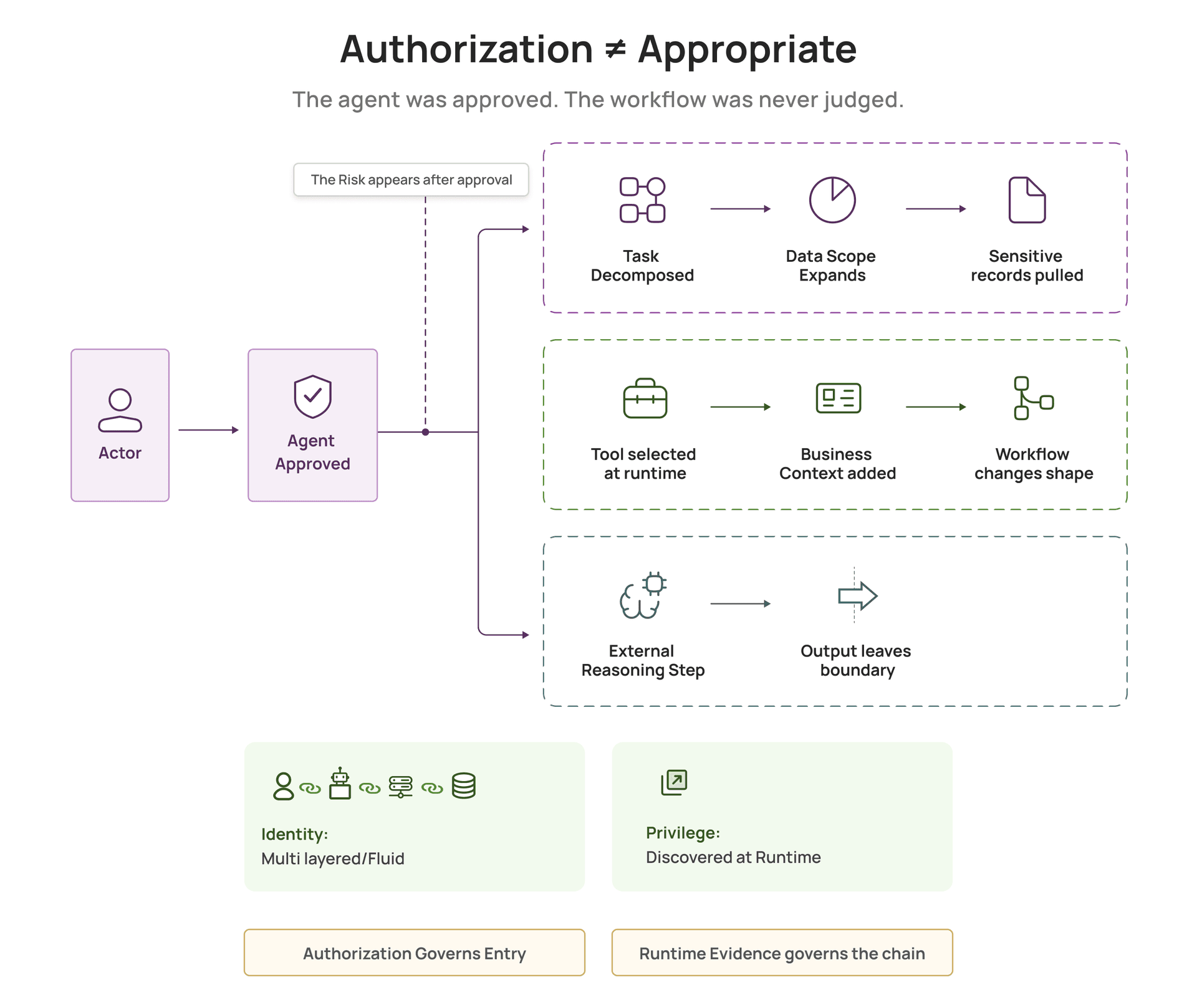
The scary agentic incidents will not begin with “access denied.”
They will begin with “access approved.”
That is the part that does not fit the threat model most security teams are running.
We have spent two decades building systems to catch unauthorized access. Block the unknown credential. Flag the anomalous login. Deny the request that does not match policy.
That model still matters. It works when the threat sits outside the permission boundary.
AI agents make this harder because they often operate inside it. They use real credentials. They call approved tools. They access systems they were intentionally connected to. They act through service accounts that already passed review.
They do not always need to bypass controls.
They just need to use the access they already have in a context where it no longer makes sense.
The agent did exactly what it was allowed to do.
A claims processing agent is deployed to help ops teams review customer cases. Properly credentialed. Gateway-approved. Service account scoped to a read-only DB principal. IAM reviewed it. Security signed off.
The controls are real.
Six weeks later, the agent queries 230,000 customer records in a single session. It touches KYC data, balance history, and NPS scores. It routes a summary to an external API.
No alert fires.
The credential was valid. The DB principal had read access. The gateway approved the tool call. The destination was not on a blocklist.
Every hop in the chain was authorized.
The access was also completely inappropriate.
Authorization was never designed to govern the chain.
In traditional systems, authorization was a useful boundary. A user had a role. A service account had a scope. If something crossed that boundary, security teams had a clear signal.
Agents blur that model. An agent does not just access one system. It reasons across tools, calls APIs, queries databases, triggers workflows, and sometimes acts on behalf of a human, all under credentials that were deliberately granted.
So the question can no longer just be:
Was this allowed?
The better question is:
Was this appropriate for this actor, this data, this destination, and this workflow?
Appropriateness is not a static permission. It depends on context. A claims agent reading one customer’s medical record for an active claim may be appropriate. The same agent reading 50,000 records across unrelated claims is not.
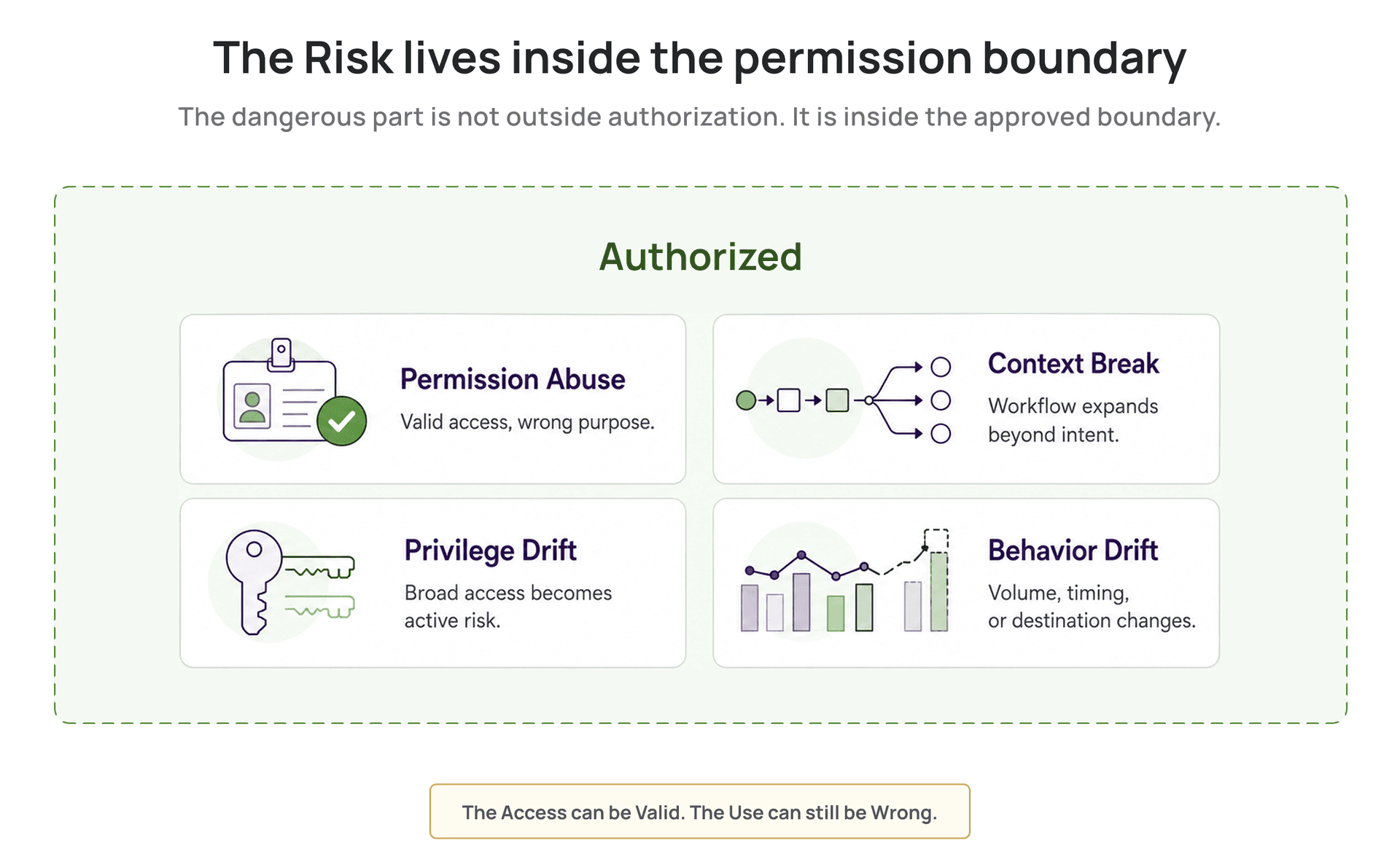
The permission is identical. The context is not.
The scary cases look normal in logs.
The bad cases do not start with a blocked login or denied API call. They start with something ordinary.
A user asks a support agent to resolve a customer issue. The agent uses an approved service account, queries the customer database, retrieves account details, and updates the ticket.
So far, fine.
Then it expands. It pulls additional records, joins another table, retrieves sensitive fields the ticket did not require, and sends a summary to an external tool.
No individual step looks insane. But the chain no longer makes sense.
Traditional monitoring sees: “Approved service account queried an allowed database.” Runtime evidence shows: “Support agent used the service account to pull 200,000 customer records, including sensitive fields, and routed them to a new external destination.”
One is an access event.
The other is a security investigation.
A few patterns show up again and again.
Agentic systems do not create entirely new security concepts. They make old problems harder to detect.
Permission abuse. The agent uses valid access for a purpose that does not match its role or workflow. IAM can tell you what the agent could access. It cannot tell you whether the access made sense. The better signal is not “this agent accessed sensitive data.” It is “this agent accessed sensitive data that does not match its expected workflow, in unusual volume, and moved it to a destination it does not normally use.”
Context break. The workflow starts legitimately, then expands into something else. A finance agent summarizes vendor payments, pulls customer bank details from a related table, and routes the combined output to an external productivity tool. At each step, approved systems. But the original purpose is gone.
Privilege drift. During development, agents get broad access so teams can move fast. Some of that access becomes permanent. Nobody reviews it. The agent accumulates permissions that no longer match its actual behavior. Posture tells you the agent is over-permissioned. Runtime tells you whether that over-permissioning is turning into active risk.
Behavior drift. The agent that normally reads 500 rows now reads 500,000. The internal assistant that normally queries one database starts touching five. The claims agent that runs during business hours starts making high-volume queries at 2 a.m. None of these signals is conclusive alone. Combined with sensitive data, identity context, and destination changes, the behavior starts to tell a story.
Logs are not enough.
Most organizations already have the events: IAM logs, database logs, API logs, gateway logs, CloudTrail, SIEM alerts.
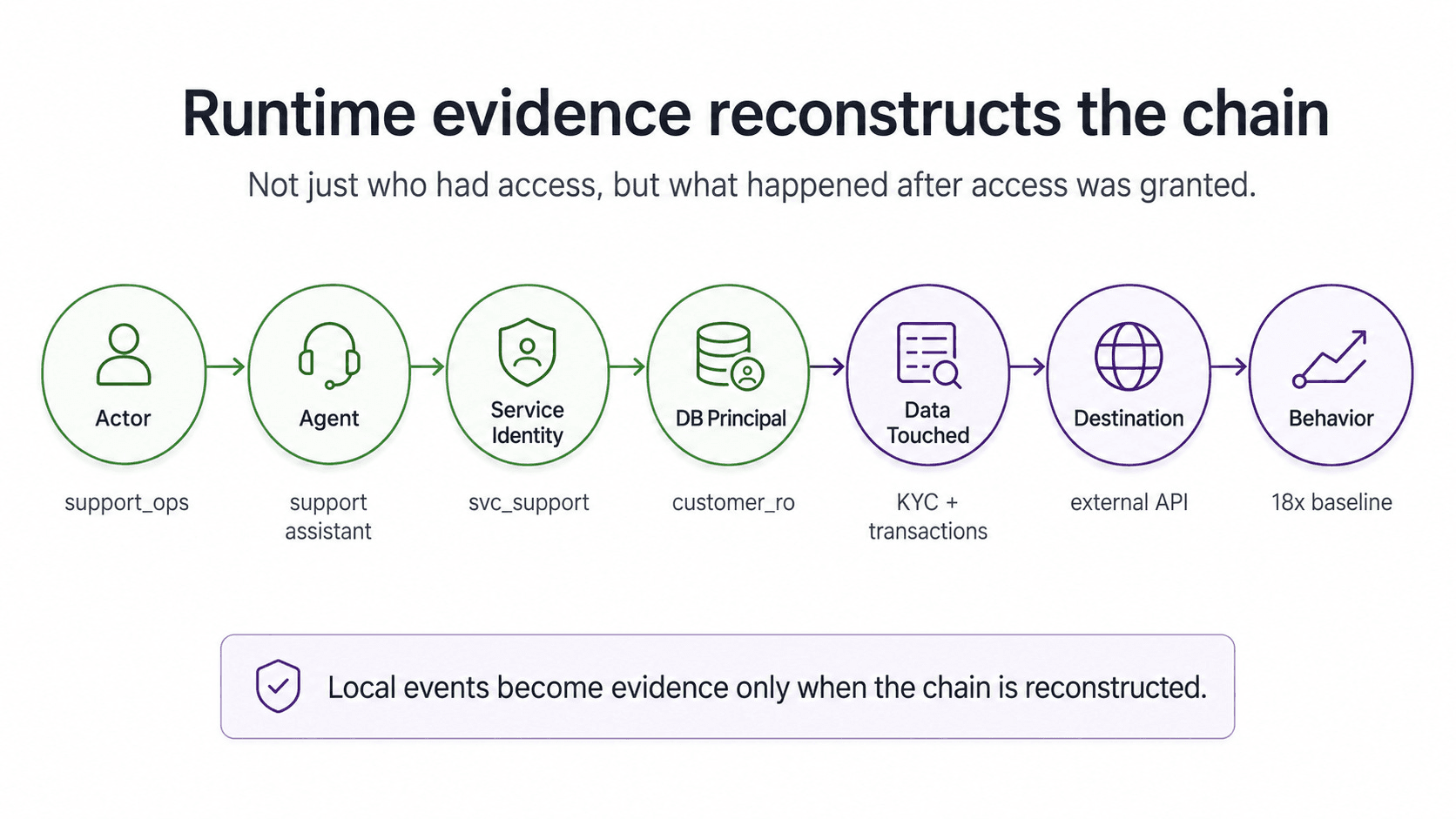
The problem is not raw data. It is that every system sees only a slice. And when every slice looks technically allowed, the real risk gets missed.
What is needed is the runtime chain: who initiated the action, which agent acted, which identity was used, which DB principal ran the query, what data was touched, where it moved, and how behavior changed.
Allowed tells you the door opened. It does not tell you whether the agent should have walked through it.
The mistake: alerting on everything.
Once teams start collecting runtime evidence, the temptation is to alert on all of it.
That will fail.
Agentic systems are noisy. Some drift is expected. Some permission expansion is planned. Some high-volume access is a monthly batch job.
The goal is not another alert stream.
It is better evidence.
A useful detection model separates:
- Correlation: stitch the chain, but do not treat it as a verdict.
- Policy signals: flag known-bad or clearly out-of-scope behavior.
- Baseline signals: detect meaningful deviation from normal usage.
- Hybrid judgment: combine policy, behavior, data, and context.
- Governance output: use evidence to reduce blast radius and right-size access.
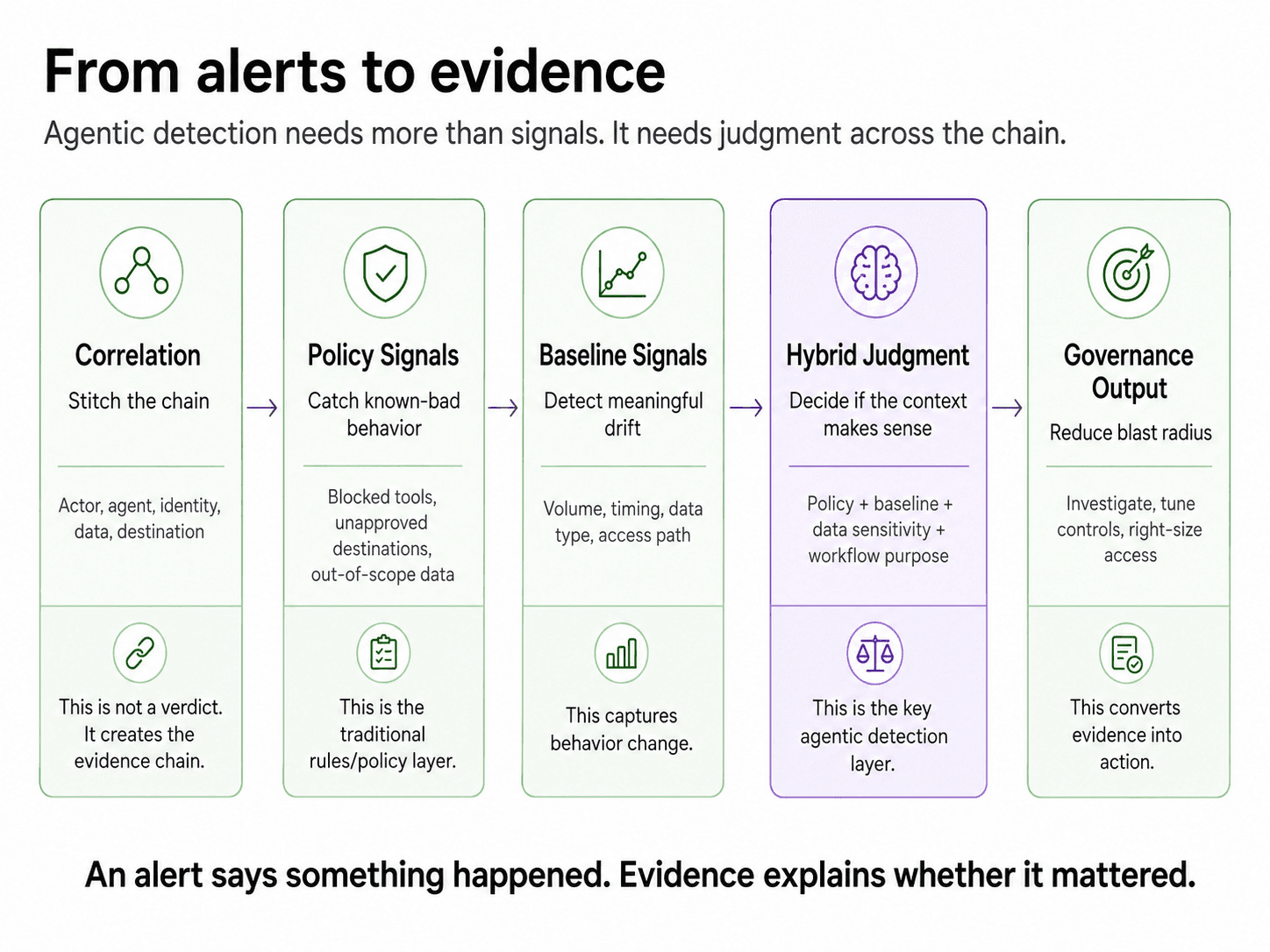
The job is to find the small number of cases where the chain of action no longer makes sense.
Not to catch every anomaly.
To catch the ones where authorized access became inappropriate.
The accountability gap is coming.
Regulators do not care that the access was authorized.
They care what data moved, where it went, and whether you knew.
The audit question for agentic AI will not only be:
Did you have controls in place?
It will be:
What did your agents actually do, and how do you know?
That question requires evidence. Not policy documents. Not gateway configs.
A reconstructable chain: actor, agent, identity, data touched, destination, behavior.
Most organizations cannot produce that chain today. Not because they lack controls. Because they lack runtime visibility.
The new detection model.
Identity still matters. Gateways still matter. Isolation still matters. But agents create a gap between authorization and behavior. Existing controls can tell you whether the access path was valid. They do not always tell you whether the workflow made sense.
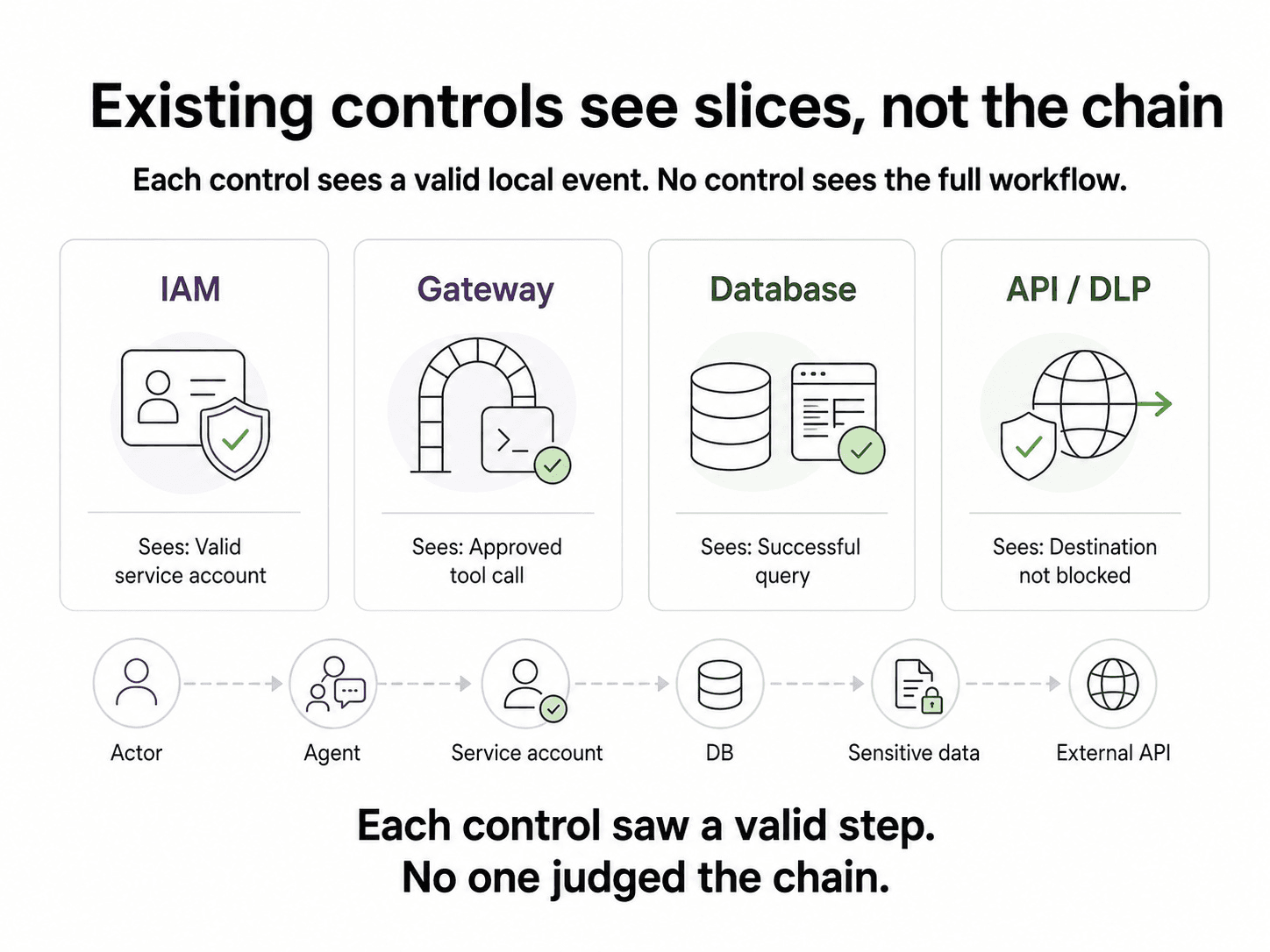
That is where detection needs to evolve.
The next model is not just about asking who had access. It is about reconstructing what happened after access was granted: which agent acted, which identity it used, what data it touched, where that data moved, and whether the behavior matched the expected purpose.
Because in agentic systems, the access may be allowed while the behavior is wrong.
That is the new detection problem.