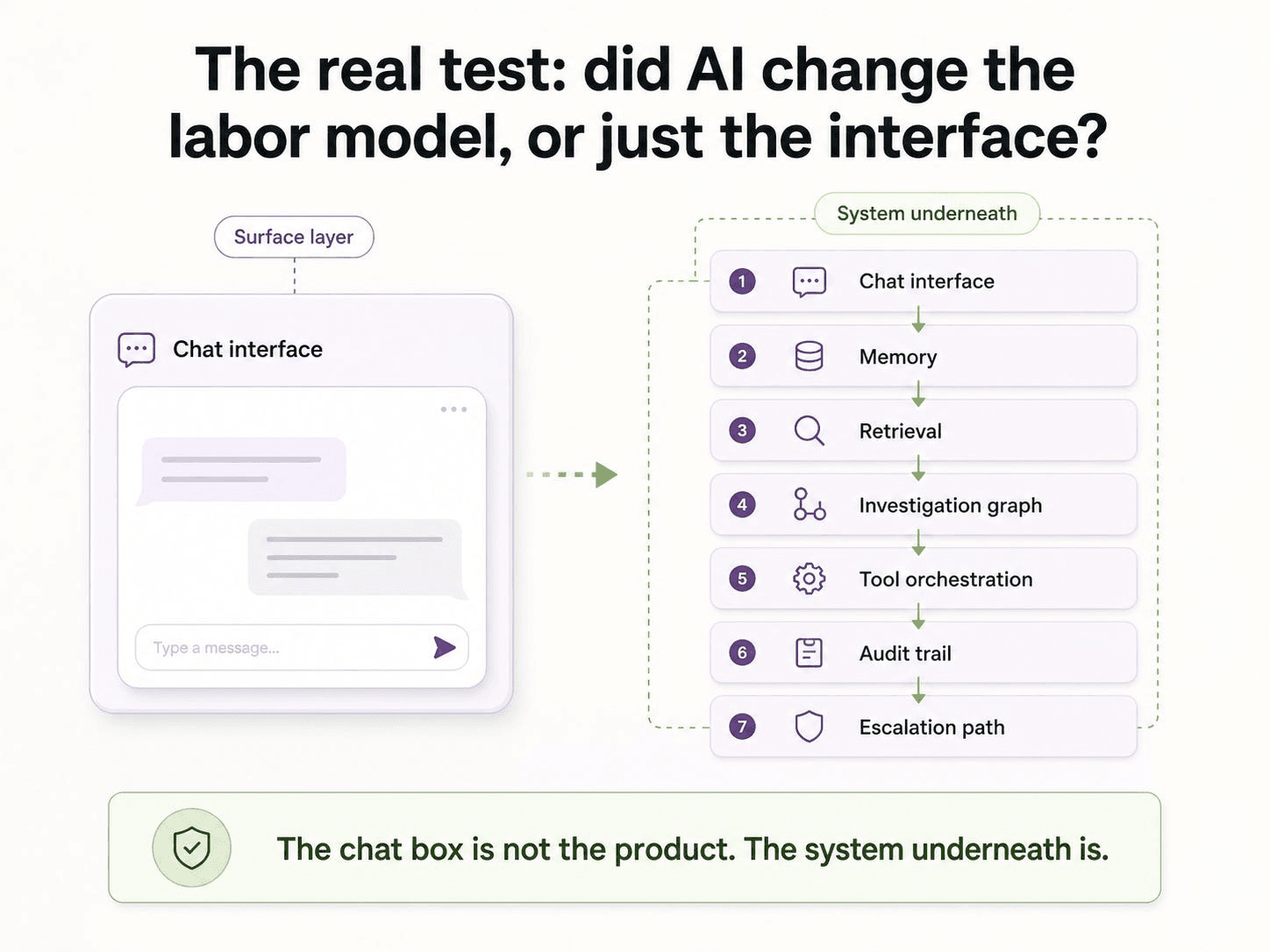
Here is the test that I see top CISOs ask for every AI-for-security vendor.
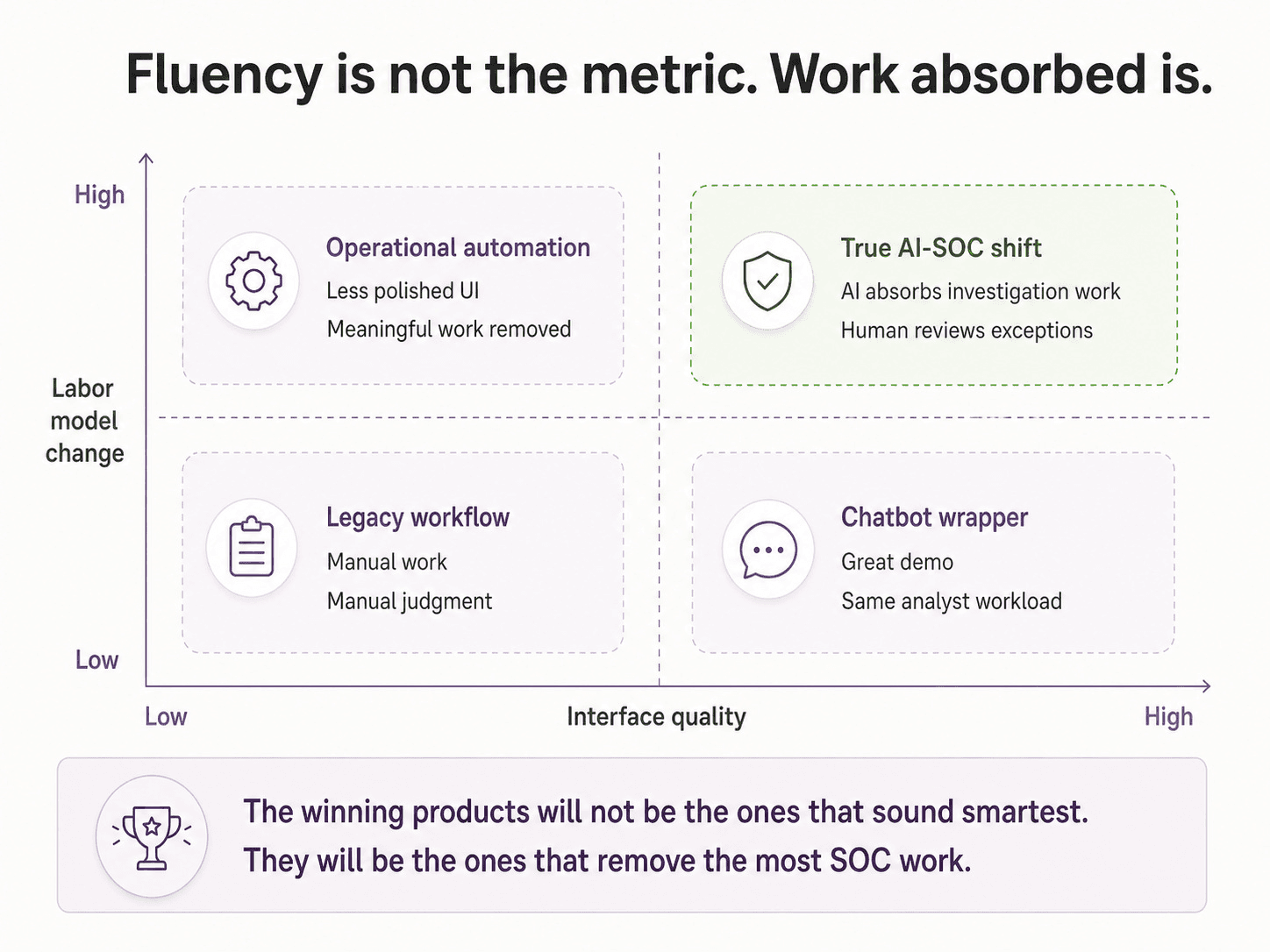
Did the AI change the labor model, or just the interface?
That is the core commercial question. Everything else is secondary.
Walk into a SOC and you can tell within ten minutes whether something real is happening. The analyst queue is the same size. The senior person is still doing the real triage in their head. The summaries look cleaner. The demo feels modern. But the same people are doing the same work, just with a more polished assistant alongside them.
That is not a bad product. It is just not the category it claitms to be.
Three Products, One Buzzword
The market calls everything “AI for Security.” That is the problem.
There are actually three distinct operating models underneath that label, and they are not interchangeable purchases.
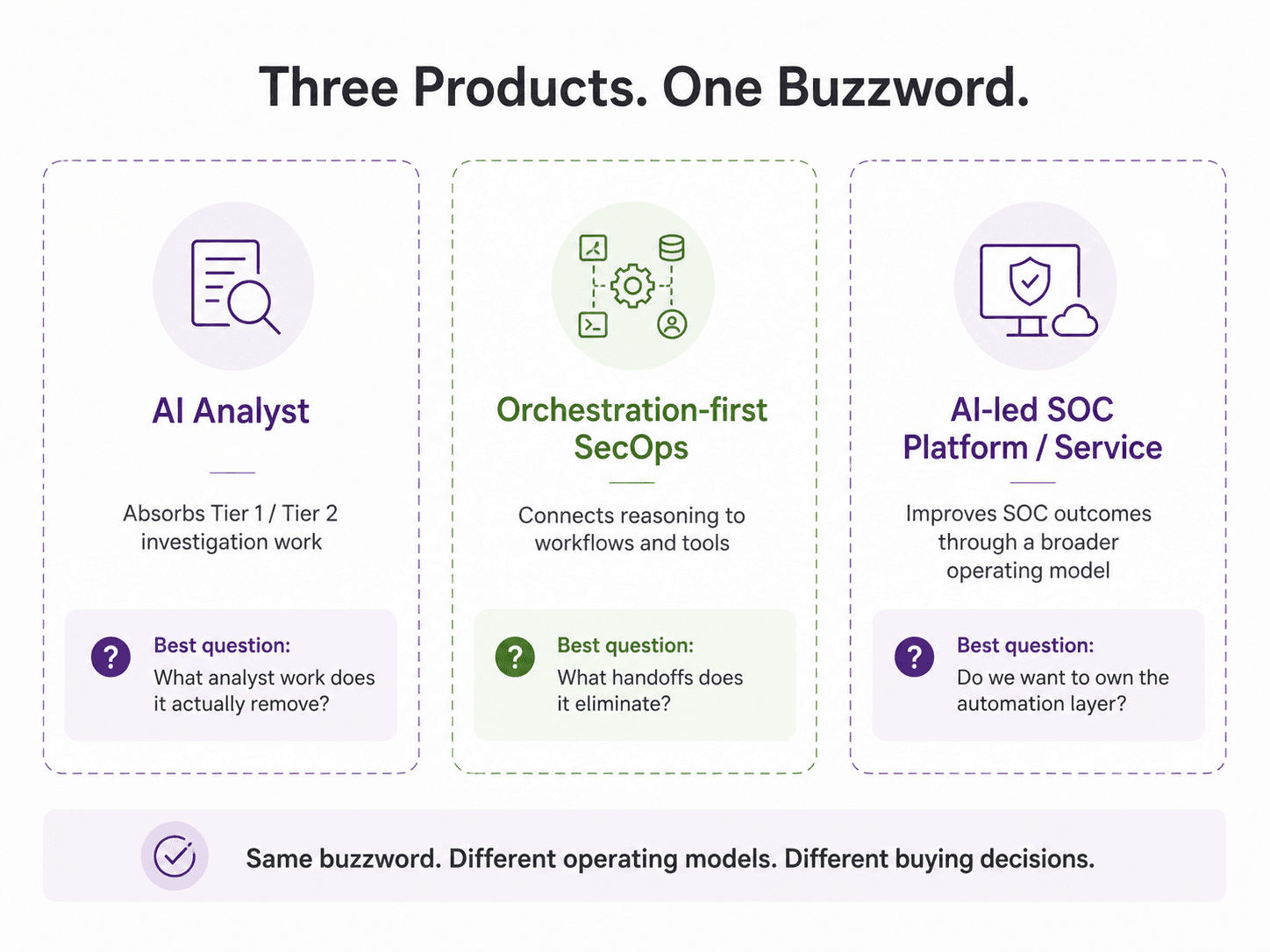
Model 1: The AI Analyst. The machine absorbs real investigation work directly. Not summarization. Actual triage, evidence gathering, signal correlation, and conclusion. Dropzone and Radiant sit here most cleanly. Their bet is that the system itself handles meaningful chunks of Tier 1 and Tier 2 work, not that it helps a human handle those chunks faster. That is a fundamentally different architecture, and a fundamentally different buying decision.
Model 2: Orchestration-first SecOps. The value is not reasoning over a single alert. It is tying reasoning to coordinated execution across tools, workflows, and the full operational stack. Torq is the clearest example. The insight here is that most SOC inefficiency is not only a reasoning problem. It is also a coordination problem. AI matters, but the substrate is workflow automation and toolchain integration.
Model 3: AI-led outcome through a broader platform. Arctic Wolf and ReliaQuest are not selling an autonomous analyst as a discrete product. They are folding AI into the operating model of a service. The buyer in this case is purchasing a better SOC outcome, not ownership of the automation. That is often the right answer for teams that do not want to build and manage their own AI layer.
These three models share language and share a demo aesthetic. They do not share a use case, a buyer profile, or an implementation reality.
Why Real SOC AI Is Architecturally Hard
There is a reason the AI analyst model is difficult to execute and easy to fake.
Real investigation work is not a single-prompt problem. It is a memory, retrieval, and orchestration problem. Investigations unfold across identities, devices, workloads, alerts, timelines, prior incidents, and external context, simultaneously, with partial information, against an adversary trying to look like noise.
A model is not enough. You need a memory layer that persists context across an investigation. You need reliable retrieval across fragmented telemetry. You need a graph-like representation of security relationships: who touched what, what changed before what, which identity connects to which asset, which alert belongs to the same chain. And you need an orchestration layer that can run multi-step workflows with bounded autonomy and a clear escalation path.
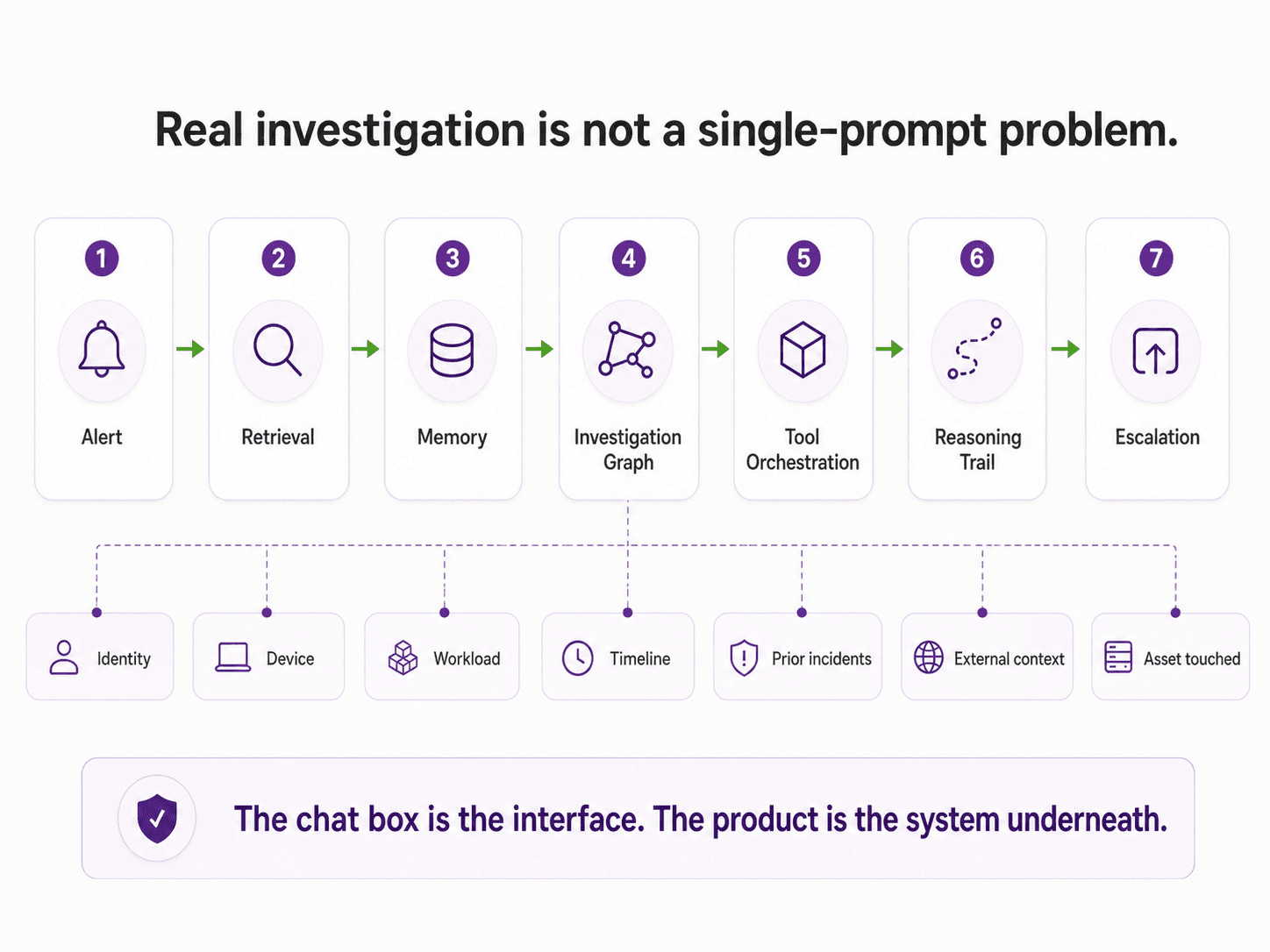
That is why the chat interface is the least interesting part of any serious AI-SOC product. The product is the architecture underneath it: the memory, the retrieval, the investigation graph, the toolchain integration, and the control system. Vendors who lead with the interface and stay vague about the architecture underneath it are, with high probability, selling a summarization layer with a modern wrapper.
The strongest signal in this category is not how fluent the demo feels. It is whether the vendor can show you what work the AI actually absorbed, how it handles uncertainty, and what reasoning trail it leaves behind for a security team to audit and trust.
How to Buy in This Market
Do not start with the AI language. Start with the operating model you want to change.
If you want the machine to absorb real Tier 1 and Tier 2 labor, the AI analyst model is what you want. Evaluate vendors on what work they actually take off the analyst, not what the demo shows, but what they can prove in a pilot against your own alert queue.
If your bigger problem is coordination, too many tools, too many manual handoffs, too much context lost in transitions, the orchestration-first model may fit better. The AI is important, but you are really buying workflow infrastructure.
If you want a better SOC outcome without building and owning the automation layer yourself, the platform or managed service route is worth serious consideration. The trade-off is that you own less of the capability over time.
The vendors are often clearer than the market around them. The confusion comes from collapsing very different operating models into one buying category.
The Real Claim
AI for Security is one of the more legitimate AI categories in cybersecurity. The underlying pain is real. The economics of changing the SOC labor model are real. And the architecture, memory, retrieval, graph traversal, and orchestration, is genuinely well suited to what modern AI systems can do.
But the market still blurs three very different products under one label. And those products require three different evaluation criteria, three different pilots, and three different conversations with your team about what problem you are actually trying to solve.
The hard part is no longer spotting whether a company mentions AI. They all do.
The hard part is spotting whether the AI changed the labor model. That is the test. Everything else is interface.
Next: Security for AI, starting with the employee layer. Copilots, coding assistants, and Shadow AI. And why it quickly becomes something much messier than a policy problem.